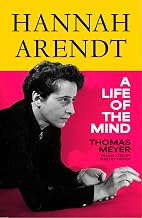
Thomas Meyer, Hannah Arendt: A Life of the Mind
Translated by Shelley Frisch
William Collins. 2026. £26. 560 pages. ISBN 978-0-00-838535-4
Reviewed by Tony Roberts
The
German-American political theorist Hannah Arendt (1906-1975) is a recognised
voice of her dark times and increasingly of our own. Hence her continuing
relevance. She wrote primarily on totalitarianism and on Jewish affairs,
offering original ideas on power and evil, on democracy and statelessness,
on tradition and responsibility. Admired as a polemicist by many, she has
always had her critics.
To
recap on the life: Johanna Arendt was a middle-class Jewish native of
Hannover, whose father died when she was young. She was raised in a leftist
family tending to the secular but never disowning its Jewishness.
Precociously intellectual, she studied at the University of Marburg, where
she came under the influence of the ‘passionate thinking’ and person of
Martin Heidegger, author of Being and Time (Sein und Zeit,
1927). They had an affair which continued intermittently for four years from
1925. She completed her doctorate in philosophy at Heidelberg, under Karl
Jaspers’ supervision, a man whom she greatly admired.
What turned Arendt from philosophy to political theory was her belief in the
greater relevance of the latter to life. As her new biographer Thomas Meyer
explains, ‘She noted that since antiquity, philosophy had been conceived of
as an abstract generalization subject to the logic of a given philosopher.
The realization that experiences could sway thinking was cast aside as
philosophers maintained their fidelity to tradition, analyzing the history
of thinking in lieu of history itself.’ As Meyer neatly expresses it, ‘what
she herself aimed to accomplish [was] to lead philosophy away from its
preoccupation with itself and toward the political sphere, which, in the
final analysis, is the human sphere.’
In
the 1930s and 1940s Arendt’s writing tended to focus on aspects of the
Jewish Question (the ongoing debate about the status, rights and treatment
of Jews) and on Zionism. Jewish assumptions of their assimilation into
German society had been found to be false. Arendt became involved in
resistance to fascism, working for the German Zionist Organization. Her
activities led to her arrest. Forced to leave Germany, she settled in France
where she worked for Youth Aliyah, preparing refugee Jewish children for
immigration to Palestine.
After the fall of France and a period of internment she knew she must leave
the country. With her second husband, Heinrich Blücher, a working-class
autodidact philosopher, she travelled to America in 1941. The relationship
between the two seems to have been based on an atypical kind of loyalty. Her
biographer refers to them as an ‘odd couple’, given their ‘social
differences, their mixed marriage, their varying political views’.
In
America she learned the language, found employment as an editor at Schocken
Books and continued her involvement with Jewish affairs: ‘From 1944 to
1952-53, Arendt was a staff member, then the managing director of the Jewish
Cultural Reconstruction.’ She wrote for Aufbau (Reconstruction),
a German language weekly. In New York critics like Alfred Kazin and Randall
Jarrell found her charismatic: deeply learned in a European way and
mesmerising in conversation (Their wives, on the other hand, often found her
dismissive).
Arendt’s writings on political theory and other subjects were bold and
original. Naturalized in 1951, she lived largely by writing freelance essays
and occasional employment through a number of visiting professorships. Her
books included The Origins of Totalitarianism (1951), The Human
Condition (1958), Eichmann in Jerusalem: A Report on the Banality of
Evil (1963), Men in Dark Times (1968) and the incomplete
The Life of the Mind. At her death, Arendt’s reputation as an
uncompromising thinker was assured.
In
1982 her former student, Elisabeth Young-Bruehl wrote a substantial,
critically admired biography, Hannah Arendt: For Love of the World.
In a cautionary note she observed: ‘A biography abundant in novelistic
descriptions of places, people, and periods would not be appropriate for
someone like Hannah Arendt. What must be shown are the historical bases for
her generalizations, the particular experiences that launched her thought,
the friendships and loves that nourished her, and — if possible —her
thinking manner or thinking style.’
This new biography by Thomas Meyer seems to have taken Young-Bruehl’s
caution on board (although it limits the attention to her ‘nourishing’
friendships). What is new is its diligent pursuit of other sources of
information on the life and work. The book benefits from comprehensive study
in a number of countries’ archives. It brings to light many details which
add depth to the portrait of Arendt and especially those connected with her
involvement in Jewish affairs. It is also arranged usefully into subsections
dealing with key moments, books, relationships and events in the life. What
emerges is a fuller picture of the Jewish Arendt, rather than the German or
American one.
In his introduction the author spells out his primary concerns: ‘The present biography focuses on two phases of Arendt’s life: her years in Paris after escaping from Germany, and the years she spent in the United States up to the publication of her first major work, The Origins of Totalitarianism.’ He stresses the Paris years (1933-1940), since Arendt spoke little publicly of her activities and yet we learn from Meyer more about her selfless commitment to Jewish organizations, which in turn counters some of the hostile accusations that damaged her reputation by her perceived criticism of Jews in Eichmann in Jerusalem in 1963.
Meyer is very good on Arendt’s forthright character [We can witness it in
action in ‘Hannah Arendt (1964) - What Remains? (Full Interview w/ Günter
Gaus) on YouTube.] Deflecting questions like those concerning feminism, she
would always assert her independence of thought and action (‘To put it very
simply, I have always done what I like to do’). He also addresses
significant aspects of her life in some detail, one being her sense of her
Jewishness. She wrote on one occasion, ‘Politically, I will always speak
only in the name of the Jews whenever circumstances force me to give my
nationality…I never felt myself … to be a German.’ She treasured the German
language, however, as her birthright.
In
the new book Arendt’s relationships with Heidegger and with Jaspers are well
explored. Indebted to both, she maintained their friendship throughout her
life, though her relationship with Heidegger was sorely tried by his
unrepentant turn to National Socialism. It resulted in a rift between the
two from 1933 to 1950. However, she could never dismiss the genius of his
early radical intrusion into philosophical tradition, his attempt to make
‘another beginning for thinking’. There is an insightful comment by
Leopoldine Weizmann about Heidegger in a letter of December 1947 to Herbert
Marcuse, quoted by Meyer: ‘The problem of Heidegger? His case is a powerful
example of how a great philosophical achievement alone falls far short of
what is needed to orient oneself in the world and how little it ensures the
self-sufficiency of the individual.’
Meyer acknowledges the role in Arendt’s thinking of other German friends
like Gershom Scholem, Walter Benjamin and her first husband, Günther Stern.
After her activist Paris years, her continued involvement with Jewish
affairs in America is a major theme. Her time at Schocken books and the
editorial projects she contemplated there (including work on a German text
of Kafka’s Diaries) is another focus. And The Origins of
Totalitarianism is explored in detail. This has been pithily described
as the ‘chilling analysis of the conditions that led to the Nazi and Soviet
totalitarian regimes … a warning from history about the fragility of
freedom, exploring how propaganda, scapegoats, terror and political
isolation all aided the slide towards total domination’ (Penguin Books).
Meyer is also informative on Arendt’s growing understanding and use of the media. As he notes, she ‘had a reputation as a brilliant, quick-witted, and skillful speaker on a variety of topics’ and was considered very quotable. Only Theodor W. Adorno could match her in the postwar world of German broadcasting. Significantly, ‘In Germany, Arendt invariably spoke as a Jew, and after 1945 always as an outsider.’ She cherished her outsider status as she did her native language.
Where I think Meyer’s biography also scores is in its frank appraisal of
Arendt’s excesses (as well as her strengths). This is important since, as
the author writes, ‘For some, everything she wrote seemed meaningful and
significant, while others found her writings false, superficial, skewed,
untenable.’ While admiring her work he acknowledges, ‘From the outset,
Arendt could be harshly judgmental of others’ ideas; she did not just chip
away at those ideas, but hacked them down.’
Eighty pages from the end of this intellectual biography, Thomas Meyer
concedes the enigma of Hannah Arendt: ‘There is not even a hint of consensus
in the hundreds of thousands of interpretations of her writings as to
whether Arendt is categorized as a philosopher, a political theorist, a
historian, a sociologist, or something else entirely. Was she first and
foremost a Jew, a socialist, a conservative, a reactionary, a feminist, a
racist, a self-hating Jew, or perhaps also a Zionist and survivor? Only
multiple attributions could come close to capturing her essence.’ Yet by the
end of the biography —as with the Young-Bruehl — we know that we are to
admire Arendt’s originality as a prescient observer of European affairs. The
daily reports of wars and of the advance of right-wing politics continue to
force our attention on her warning that the price of freedom is vigilance.
Those readers like myself who are most interested in Arendt’s American
period and her relations with its intellectuals—the critics, novelists and
poets she entranced— may find her New York time is covered patchily in
Meyer’s book. Should the reader be interested in her ‘genius for friendship’
in America, there is the earlier biography by Young-Bruehl to go to, as well
as a marvellous collection of the correspondence between Arendt and Mary
McCarthy, Between Friends, 1949-75, edited by McCarthy’s biographer,
Carol Brightman. For others, this excellent biography may well be enough.