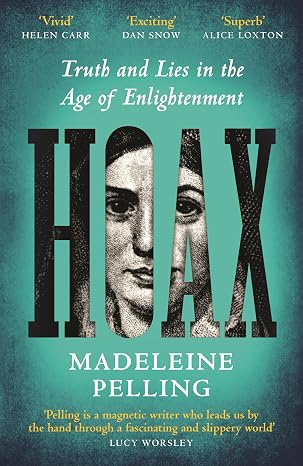
HOAX : TRUTH AND LIES IN THE AGE OF ENLIGHTENMENT
By
Madeleine Pelling
Profile Books. 351 pages. £22. ISBN 978-1-80522-235-4
Reviewed by Jim Burns
In
January 1762 people, both rich and poor, the supposed-intelligent and the
alleged-ignorant, were flocking to a house in London’s Cock Lane, where, for
a price, it was possible to be in the presence of a bed-bound young girl and
hear the knocking and scratching that seemed to come from the walls of the
shabby room. The knocks were said to be responses to questions asked of
whoever it was that was thought to be haunting the house, and would
eventually lead to false accusations of murder and other crimes.
There is a story behind these events, but it would be unfair to Madeleine
Pelling for me to outline it here. Her engaging book has all the details,
told in a colourful way and involving questions of class, money, love and
betrayal. Pelling’s aim is to show how it was easy to persuade the gullible
to believe in the possibility of communication with the dead and how
passions could be swayed by what might be disclosed. But hoaxes did not only
involve ghostly visitations. They took various forms in their efforts to
deceive. There was, for example, the case of Mary Toft, “a woman supposed to
have given birth to rabbits”, and which even attracted the attention of some
eminent medical men. As Pelling says: “The affair, eventually dismissed as a
fraud, was fraught with class and gender politics, and left a bad taste,
particularly as it had implicated so spectacularly some of the most revered
minds of the elite”. Mocking those minds could be great fun.
No doubt the audiences applauding the well-known actor David Garrick
in his intermission skit, The Farmer’s Return, a satirical comment on
the story of the Cock Lane ghost, knew who they were laughing at.
In
many ways it was not surprising that these demonstrations of trickery did,
for a time at least, manage to fool people : “The gleaming squares and grand
institutional buildings of London may have screamed rational enlightenment,
but in back alleys and on street corners the city teemed with mesmerists,
fortune-tellers, and liars”. In
fact, I suspect that more than a few of the inhabitants of those “gleaming
squares” and “grand institutional buildings” may not have been all that far
removed from the influence of some of those “mesmerists, fortune-tellers,
and liars”. If, as Pelling says, “Britain in 1762 was a nation at odds,
grappling with a serious debate over the nature and validity of belief”,
then minds were more than likely to be still struggling to cast off all
vestiges of old beliefs. As the lady said when asked if she believed in
ghosts, “No, but I’m frightened of them”.
It
makes one wonder how far Enlightenment ideas had spread outside London.
Pelling has a close look at the exploits of Mary Bateman, a woman hanged at
York in 1809. Her story abounds with anecdotes of how she milked the
credulous of money and goods by playing on their belief in the efficacy of
spells, potions and predictions to get what they wanted. She was born into a
farming family in 1768 in Topcliff, “a small village to the north of York”.
As a child she seems to have had a tendency towards stealing and lying, if
later accounts of her life are to be believed, and when she was twelve, she
was sent to Thirsk to become a servant in a house there. Pelling says “For
seven years, this was Mary’s life, up with the dawn, only permitted to flop
exhausted into bed long after her employers had retired to theirs”.
The seven years were not spent in the same house, Mary only “staying
long enough to pass a season or two, but always discovered in some trick or
lie, and forced to move on”. She eventually drifted to York where she
perhaps “first began practising magic in earnest”.
Her
next stop was Leeds, a city central to the Industrial Revolution with a
growing population, mostly drawn from the countryside as the old cottage
industries went out of business and
new purpose-built factories replaced them. Mary escaped being drawn
into factory life and obtained a post with a local dressmaker. It’s not
clear how long she stayed there, but she was twenty-eight when she married
John Bateman, a wheelwright. A large fire at a local mill resulted in
injuries and unemployment, and people were asked to donate old linen for use
by the hospital. Mary went from door to door collecting what she could, but
instead of passing it to the hospital she sold it, “keeping the money for
herself”.
Mary also had additional ways of earning money, and Pelling narrates that
she was gaining a reputation as a source of “spells and manipulations” for
those who needed them : “She would take payment to turn lovers’ heads, to
prevent elopement and enrich passions, to ward off violence, and to keep the
misguided or disillusioned on preferable paths”. Pelling says that the
services offered by Mary sometimes involved abortions, including one in
which a young woman died. She got to know two sisters, Quakers who had a
linen draper’s in Leeds, and in due course she was asked “to read their
destiny in the stars”, as well as looking after their domestic arrangements,
including making their meals. Both
sisters fell ill and died, and their mother, who had travelled from
Wakefield to look after them, soon followed them to the grave. Mary told
locals who enquired that the deaths had been caused by cholera. Later,
because there was no-one left to inherit the shop, and bailiffs were called
in, they found the premises, both business and domestic, stripped of all
contents, and the account books missing.
It
seems curious that the deaths and the missing property do not appear to have
aroused suspicions among the authorities, though a doctor involved was of
the opinion that all three victims had been poisoned. He wanted to carry out
autopsies, but there was no living family member who could grant permission.
And so, Mary continued, advising a Mrs Rebecca Perigo, who was convinced
that her illness had been caused by “an evil wish”, to eat a pudding
prepared by a mysterious Miss Blythe from Scarborough. She did, along with
her husband, William, and additionally imbibed some honey Mary had provided.
Both were violently ill, and Rebecca died. William recovered and alerted
William Duffield, the Chief Constable of Leeds, about his suspicions that
they had been poisoned by Mary. She was arrested.
She
was tried in York in March 1809, and the result was a foregone conclusion,
the evidence against her being overwhelming. When the police had raided her
home they found numerous items that Mary had persuaded William to send to
the non-existent Miss Blythe as payment for the services, including the
lethal pudding, she had supposedly provided. What is a mystery is that
Mary’s husband denied all knowledge of what she had been doing. He was never
tried as her accomplice. She was convicted, sentenced to death, and hanged
on the 20th March 1809. After her death her skin was flayed and
used for binding books, one of them a 1635 edition of Richard Braithwaite’s
Arcadian Princess, which went to the library of the Earl of
Mexborough in Wakefield.
Mary Bateman’s hoaxes led to several grisly deaths, including her own, but
the curious saga of Caraboo does have its lighter side, mainly because of
the way the well-meaning were initially taken in by a lady claiming to be a
princess from an island in the Pacific. It all started one day in 1817 when
a strangely dressed woman, speaking an unknown language, stumbled into a
house in Almondbury, near Bristol, and
collapsed. When she was revived no-one could understand what she was saying,
so eventually she was taken to the home of Samuel Worrall, the local JP,
town clerk, and banker, and his wife, Elizabeth, an American.
They too were at a loss as to what to make of her, so she was moved
to the local hospital, which also served as the workhouse. But Elizabeth
Worrall, a kinder person than Samuel, took pity on the stranger and brought
her back to live with them.
It
was then, you might say, that the fun started. At some point the woman
somehow managed to tell the Worralls that her name was Caraboo and that she
was a princess from the Pacific island of Javasu, which was taken to be
somewhere near Java. An interesting occurrence was when a Portuguese sailor,
who had landed at Bristol and heard about Caraboo, turned up at the Worralls
and seemingly conversed with her and confirmed her story which involved
being kidnapped by pirates, escaping, and finding herself on the dockside in
Bristol. If that was true it should have caused questions to be asked about
how she managed to get to Bristol. Surely someone would have acknowledged
transporting her?
The
presence of Caraboo in Almondbury became something of a sensation, and lured
visitors to the area to look at her. Caraboo, in turn, was happy to perform
for them, swimming in the lake and performing exotic dances. One of those
whose interest had been aroused was a Doctor Charles Wikinson, known for his
experiments with Galvinism, a process using electricity to prompt live
actions in dead frogs. He was a showman, and an opportunist, and
enthusiastically promoted Caraboo as the real thing. Her fame spread and her
portrait was painted by Edward Bird, a noted artist of the day.
The
whole edifice of the hoax came tumbling down when a couple of people
recognised Caraboo for who she really was, Mary Willcocks, born in a village
in Devon to a life “on the edge of poverty” and never having left England.
Pelling delves into the details of
her unmasking and Mary’s subsequent adventures which took her to America to
perform on stage as Caraboo. It might be thought that she would have thrived
there, with its travelling minstrel shows, carnivals and other activities
where “hocus pocus” (the origin of “hoax”) was practised. And think of
Herman Melville’s novel, The Confidence-Man.
Mary, however, failed to make her
mark and eventually returned to England and obscurity. Unlike Mary Bateman
she had never harmed anyone, other than in making them (particularly the
claimed superior classes) look foolish in the eyes of the general public,
and the only punishment that could
be inflicted on her was by trying to forget that she ever existed. Mary died
in 1864.
Pelling points out how the Press, local and national, had initially taken up
the stories of ghosts, spells, and lost princesses, with great enthusiasm,
but soon turned on the practitioners of hoaxes once their real identities
and practices became evident. It probably isn’t much different now when
anything similar occurs.
On
the subject of the contemporary, Pelling says that, while the old tricks
have gone, “In their place, we consume the performance of truth and lies
through a screen carried about in our pockets and shared online”. I like to
leave the final word to Horace Walpole : “however enlightened an age may be,
knavery and folly need never despair”.
Hoax
is a book that might be said to take a popular approach to history. It is
thoroughly researched, with ample notes, but is written in a way that
invites readers to continue turning pages to find out what happens next. In
fact, it could be said that it reads almost like a novel, with situations
described in the present tense (“Mary sensed danger. She begged him to see
reason; she had, she said, done nothing wrong”.) and dialogue similarly
constructed (“To Bombay”, came the reply, “as a nursemaid to a European
family”.). It works well. Like Madeleine Pelling’ earlier book, Writing
on the Wall, (see my review, Northern Review of Books, April,
2024 ), Hoax is a pleasure to read.