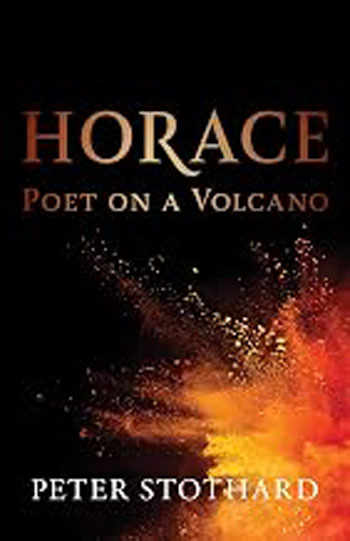
Horace: Poet on a Volcano
By Peter Stothard
Yale University Press. 328 pages. £18.75. ISBN-13: 978-0300256581
Reviewed by Tony Roberts
While the cultural world’s attention has been on whether Christopher Nolan’s
film of The Odyssey reflects or distorts Homer’s vision of Greek
manhood, the adventures of another favourite ‘ancient’, the Roman poet
Horace (Quintus Horatius Flaccus), may have slipped by some readers. It
would be a pity were we to miss Peter Stothard’s Horace: Poet on a
Volcano, which is a dynamic exercise in classical scholarship.
Horace (65 BCE to 8 BCE) famously wrote in a number of forms: odes, epodes
(which are often fierce where the ode is calm), satires and epistles (verse
letters). Like many others I return to him (in translation) for his warmth
and wine, for his relaxed and affable poetry indulgent of human weakness.
This is the man who remembers that ‘Life is short’ and so must be seized.
Characteristic, in this view, is his ode (Book 11:11) which ends —in the
translation by the excellent Irish poet Eavan Boland:
For
the god of wine is the enemy of care.
And which slave-boy will bring us
water now
From a fast stream to cool down and temper
Our bowls of Falernian fire?
And
as for Lyde, who is going to persuade her,
Shy as she is, to leave home
and join us? Tell her to hurry.
Tell her to come, dressed
Laconian-style, with
Her ivory
lyre and her hair neatly tied.
His
Horace is somewhat more dangerously radical—as his subtitle suggests—as well
as being frequently vituperative and bawdy.
The volcano image comes from a poem in which the poet evokes the end
of Empedocles, later immortalized for Victorian readers by Matthew Arnold as
the philosopher who flung himself into Sicily’s Mount Etna as a ‘devouring
flame of thought’. Or, in Horace’s case, with a yearning for immortality.
Stothard’s Horace is the veteran wounded by war and living with anxiety, ‘a
wild poet as well as a mellow one’, who ‘left behind a unique legacy of dark
insecurity, bright pleasure, love, anger, and gratitude for life’. He was,
as the author says, a modernist in an ancient world, taking the traditions
of Greek poetry and remaking them for his own times. That he should live in
‘dark insecurity’ is entirely fitting, since he survived and ultimately
prospered in turbulent decades —the years of Caesar, Brutus and Philippi (42
BCE), Mark Antony, Cleopatra and Actium (31) — and he witnessed the triumph
of Octavian as Augustus, when the republic turned empire four years after.
Horace was born in south-east Italy, in Venusia. His father was an
auctioneer of the property of war victims and, more significantly for his
son’s identity, a freed slave. War and his origins were to define the poet’s
life. As a young man Horace gave up his studies in Greek poetry and
philosophy in Athens to become an idealistic student-adventurer, throwing in
his lot with the losing, Republican army of Brutus (‘more fatalistic
philosopher than tactician’) after Caesar’s assassination. His experience on
Brutus’s staff, as Stothard reminds us, was that of an invader. The
tyrant-killer became a tyrant himself, leading his army to the destruction
of Greek cities in Asia.
At
the battle of Philippi the opposing army of Caesar’s heirs, led by the
avenging Octavius and Mark Antony, won a confused victory. Like many others
Horace threw away his shield and showed what used to be called a clean pair
of heels. Fortunately, the young man was amnestied. To Stothard, ‘Horace was
forever after, in ever different ways, a war poet. He absorbed what he saw
and held it for release in fragments over the rest of his revolutionary
creative life.’ The idea of escape became ‘a widening theme’ of his poetry,
and his energies were directed toward seizing ‘the gift of the present’ (‘Dona
praesentis cape’).
Returning to Rome, Horace found he had lost his father and their property,
but he managed to gain employment as a secretary for the treasury. Brutus’s
defeat may have cost the young man dearly, yet he had nevertheless ‘advanced
himself on the losing side’. Arguably ennobled and ambitious, this ‘short,
tubby poet, with no fondness for unnecessary physical exertion’ devoted
himself untiringly to his poetry.
Horace’s early efforts focused on the urban squalor he saw daily in the
Subura (near the Forum area of Rome). He adopted a prurient attitude to its
depraved inhabitants (‘I smell octopus and goat in your armpits’; ‘You ask
me why your long decaying body keeps my cock limp.’), Soon he would turn his
attention to the newly rich and the enemies of Octavian’s new order, naming
names in his verses. The author is very good at turning the invective in
some of these poems into illustrations of Horace’s personality and progress
through Roman society, to the point where he could make capital out of his
own lowly origins while eviscerating the newly rich.
As a
poet he had literary models, like Archilochus, but was also an admirer of
Vergil, a fellow perfectionist and the great poet of Rome’s ancestry, in
The Aeneid. Through the eventual recognition of his own less ambitious
poetry and from Vergil’s intercession, he joined the literary circle of
Maecenas (in 37 BCE), whom Stothard describes as ‘rich, flamboyant, a proud
Etruscan’, not a senator but close to Octavian, an eager but not overly
accomplished writer, who enjoyed wine and dining on ‘roasted donkey’.
What
Horace most wanted, aside from perfecting his poetic technique and finding
such a patron, was to escape: ‘The press of the dying at Philippi, the press
of the living on the Esquiline slopes: both were weights that he wished to
cast away.’ His obsession became a reality when Maecenas granted him a
modest estate (a villa and small farms) in the Sabine hills ‘thirty miles
northeast of Rome, rustic and even closer to Tibur, Rome’s metropolitan
holiday resort’.
Horace cherished Maecenas’s gift (‘This sweet, and, if you will believe me,
charming retreat keeps me in good health during the autumnal days,’ he wrote
to a friend). Yet he could never be certain of his world, his continuing
favour in it, nor of the shadow of mortality:
Pale
death beats with the same foot on the hovels of the poor
as on the towers
of kings. O blessed Sestius,
the very shortness of life forbids us to
begin long hopes.
Generally, Horace’s poems had become more ‘melancholic, contemplative, with
a powerful sense of passing time and an equally powerful belief that his
poetry could mitigate time’s decay’. He was still Stothard’s war poet, his
poet on a volcano, when the shorter, fourth book of odes appeared four years
later. Throughout it ‘sounded the continuing sense of uncertainty, fear of a
fall… and the desperate tread of marching time. The contrast between
nature’s permanent renewal and our inability to renew was intense.’
Eyeing his death, which would occur in 8 BCE (the year of his patron
Maecenas’s), Horace looked to the pleasures of the present and to the future
only in terms of his reputation as a poet. There immortality might lie. In
this he would be both gratified (in his status as a poet and the survival of
his poetry) and appalled (at the way it could be butchered in the teaching).
As we learn, he became the darling of romantic poets and
statesmen-translators like John Quincy Adams and Gladstone, as well as
philosophers like Nietzsche.
There is much interesting detail in Peter Stothard’s book on the
politico-military context of the time and on individual Romans who figured
in Horace’s life. His book has the great merit of interrogating the poems in
a lively way to reveal the poet’s moods and attitudes. He ends his intimate
study by underlining the fact that ‘the poet lives somewhere behind his
lines’. His biography successfully illustrates that.