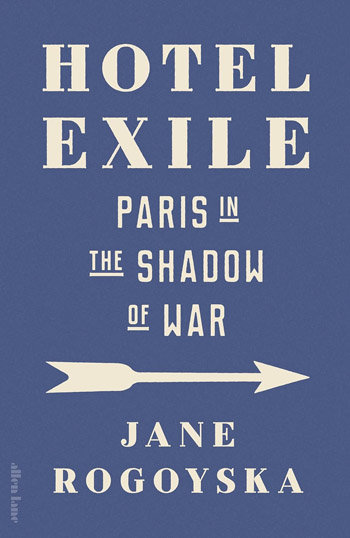
Hotel Exile: Paris in the Shadow of War
By Jane Rogoyska
Allen Lane. 368 pages. £25.
ISBN: 978-0-241-67963-0
Reviewed by Tony Roberts
Jane Rogoyska’s excellent Hotel Exile is the biography of a hotel, of
refugees, of a city and a time. It is one of those books in which the author
alternates between a large cast of characters, some of whom are well known.
The reader follows their fortunes —in the relentless present tense—in the
context of Hitler’s seizure of power and the subsequent persecution of Jews
and political opponents in Germany and then in France.
The book’s main focal point is Paris and its famous
Hôtel Lutetia. That is to
be found on
Boulevard Raspail,
in the Saint-Germain-des-Prés area
of the 6th
arrondissement
on the Rive Gauche (Left Bank). Designed in the
Art Nouveau
style and built in 1910, it was established by the owners of the Bon
Marché department
store, which sits opposite. At the time the hotel, named for an early
pre-Roman town,
offered ‘attainable luxury, its clientele pulled mainly from the French
provincial bourgeoisie’.
Its history from the thirties to the late forties is particularly
interesting. Pre-war it offered a meeting place for
any number of artists, musicians and politicians. With the invasion of
France in 1940, the
Hôtel
Lutetia became the
headquarters of the German military intelligence service. At the war’s end,
in a dark irony, it was used as a reception centre for deportees released
from concentration camps. The book is therefore divided into three sections:
‘Before:1933-1939’; ‘During: 1939-1944’; and ‘After: 1945’. The first part
is interesting, the second grimly so, and the third, inevitably,
distressing.
Rogoyska’s characters are a diverse group, their often tragic experiences
escaping Germany to a hardly welcoming France are documented by the author.
They include Heinrich Mann (novelist brother of Thomas), Gisèle Freund
(photographer), Anna Seghers (novelist), Gustav Regler (journalist), Willi
Münzenberg (Communist propagandist), Eva Tichauer (schoolgirl daughter of a
Jewish lawyer), Walter Benjamin (cultural critic) and James Joyce. His
friend Samuel Beckett figures briefly. For all, these are years of
desperation and frustration. Those writers who stubbornly remain at
makeshift desks produce what the author calls exilliteratur. In a
memorable phrase, Hans Sahl the poet and critic describes them as trying to
‘give meaning to time’. Mann, in contrast, is very active in anti-Fascist
circles, taking on the leadership of various committees and travelling
repeatedly to Paris and the
Hôtel Lutetia from
his temporary home in the south of France. The shabby, suddenly impoverished
refugees are excluded from the hotel.
Rogoyska is very good at contextualizing the lives of her characters in the
relevant background events in Germany and France. She reminds us of key
dates that impact on the lives of individuals, increasing the diaspora of
enemies of the state. In February 1933, for instance, Chancellor
Hitler seizes the opportunity of the Reichstag fire to arrest almost four
thousand members of the KDP (German Communist Party), plus other listed
enemies including, briefly, Anna Seghers. This leads shortly to the
revocation of all civil liberties. For those opposed to National Socialism
it is a clear signal to flee Germany.
Those who take note include the leading figures of the Weimar Republic’s
largest party, the SPD (the Marxist-influenced German Social Democratic
Party). Others include writers like Lion Feuchtwanger, Walter Benjamin and
Mann. On March 16th the first refugees arrive in Paris, six days
before the concentration camp at Dachau opens. Those who hesitate to leave
Germany and their language behind must wonder whether this N. S. government
will survive longer than recent others. For some, a critical stage in their
children’s education becomes a paramount and fateful consideration.
It is not long before conditions in France worsen for the German refugees,
as anti-Semitic mutterings are heard. New measures in 1934 deny foreigners
residence permits if they lack work permits:
‘Sooner or later, everyone ends up committing an offence, whether
knowingly or not. First off comes the blue paper: refoulement (being
sent back). Next is the pink one: expulsion.’
There are brief optimistic respites. Münzenberg organizes the first Congress
for the Defence of Culture in June 1935, which is attended by two hundred
left-wing writers from thirty-seven countries (including Malraux, Pasternak,
Brecht and E. M. Forster). In September he organizes the Lutetia Committee
with fifty politicians and intellectuals. They meet several times to forge a
united front and, hopefully, a new German constitution. These doings are
shadowed by German agents and French police. This same month Hitler’s
Nuremberg Laws make official the persecution of the Jews on the basis of
race.
The 1936 election of a Popular Front government in France (under Léon Blum)
unites leftist parties against fascism. All German refugees are issued an
identity card guaranteeing freedom of movement. Factions emerge in Blum’s
government when it remains neutral during the Spanish Civil War. By 1938 the
party is dissolved and gains are lost. This is the year of Austrian
annexation (the Anschluss ) and the third Moscow show trial.
In November the shooting of a German embassy official in Paris leads
to Kristallnacht and violent pogroms against Jews in Germany, which
brings more refugees to France. Daladier’s new centre-left government there
tightens conditions of residence for foreigners. The initial welcome has
been replaced by latent hostility and, with the growing threat of Fascism,
all Germans become suspect.
In this first part of Hotel Exile, the Lutetia is only sporadically
the focus, but it is central to The Occupation. On June 14th 1940
German troops enter a deserted Paris. The branches of the invading police
—the SS (and its intelligence branch, the SD) as well as the Gestapo (the
secret police) —commandeer the big hotels of the right bank. The
Hôtel Lutetia on
the left bank is taken by the Abwehr. It is tasked with operations
against enemies of the Reich, though never entirely trusted by the Nazi
regime. It’s head, Admiral William Canaris, ‘a fluent French speaker and
connoisseur of fine cuisine’, is not in favour. A noticeably small, shabby
and unhappy man, Canaris is always accompanied by his two devoted sausage
dogs. He is nevertheless a workaholic, extremely adroit at surviving within
the Nazi system, but ultimately uncommitted to it.
The new station commander of the hotel is Colonel Friedrich Rudolph,
seasoned in military espionage. He arrives on June 15th 1940,
before the official French capitulation. He organises the hotel into working
and living quarters. The building is out-of-bounds to the public, a military
switchboard is introduced and rooms designated for storage, the mess, etc.
The staff will increase to over one hundred. Officers and operational staff
are given rooms on the lower floors. Senior officers like Reile have a
bedroom and an office. The service staff remain the discreet French. Since
the Germans control the exchange rate, prices are very low. Life is very
good for the occupants who work and play free from scrutiny.
The former Chief of Police of Danzig, Colonel Oscar Reile, is assigned to
the Hôtel Lutetia
to head the military counter-espionage section. He will look to increasing
the number of agents and interrupting resistance networks in the occupied
zone. On June 22nd 1940 Pétain signs an armistice with Hitler. In
July of that year the Vichy government begins revoking the citizenship
awarded to ‘aliens’ naturalized after 1927: ‘All visas and permits are only
temporary, so the effort to co-ordinate the necessary entry, transit and
exit visas requires a balancing act of rare delicacy. In the meantime, the
refugees must survive with the help of aid committees, which provide them
with food, meal tickets, handouts, cash.’
Rogoyska’ s attention then switches to the South of France (and some of the
same characters followed in Uwe
Wittstock’s new book, Marseille 1940: The Flight of Literature). We
learn of the escape of Mann, Feuchtwanger and the attempt made by Benjamin.
In Marseille, the lawyer Alfred Kantorowicz finds the city “stuffed full of
Nobel Prize winners, poets, professors, senate presidents, clergymen,
princes, ministers, excellencies’.
In Paris German politeness fades. French resentment at its refugees becomes
even more marked. In December 1941 Hitler issues the directive Nacht und
Nebel (Night and Fog), dispensing with legal procedures when seizing
‘suspicious’ citizens. That month America enters the war and French hopes
are encouraged. Meanwhile betrayal is a constant possibility for
résistants. Perhaps the most despicable of the men we meet in the book
is Reile’s agent, Robert Alesch, a priest who betrays a number of resistance
cells. Soon, however, the Abwehr’s network is taken over by Himmler’s
Gestapo/SS.
In June 1942 Jews in the occupied zone are required to wear a yellow star.
The following month the Paris police arrest almost thirteen thousand foreign
Jews, whether or not they hold French citizenship. They are sent to the
Drancy camp and on to Auschwitz. In November, with the arrival of the Allies
in North Africa, German occupation is extended to the whole of France. The
number of resistance groups increases, the communists being the most active
and well-organised (They have been building since Germany’s betrayal of
the Molotov–Ribbentrop Pact in June 1941). Because the war is going badly in
the East and South, German troop withdrawals are required. The number of
military personnel in Paris drops from 40,000 to 15,000
by 1943. The German war rapidly deteriorates. And then, on August 25th
1944, Paris is liberated, ‘nine deadly months’ before the war’s end.
The third section of Hotel Exile again focuses on the role played by
the Hôtel Lutetia, now a
repatriation centre assisting with the largest number of returnees. On
arrival the released prisoners are showered, medically examined, fed, issued
an identity card and, where possible, questioned. One observer describes the
dazed, skeletal returnees: ‘They stared right through you. It was very hard
to look at them, their gaze was blank, there was no sense of their being
happy. I don’t think they realized it was over.’
The first arrivals at the
Hôtel Lutetia appear in late April 1945, over eight hundred survivors of
four concentration camps. Buchenwald has held the most French prisoners. As
many as five hundred returnees a day pass through the hotel —notionally for
a one-or two-night stay— to be catered to by almost six hundred volunteers.
The author gives us several poignant examples of the immediate experience of
return.
We are placed in the moment. A crowd waits at the Hôtel
Lutetia for a bus bringing concentration camp inmates home: ‘Their eyes are
fixed on the bus’s windows, where rows of passengers are just visible behind
the dirty panes. From the hotel entrance a group of young volunteers emerge,
clad in scout uniforms. Inside, the passengers do not stir. They seem to be
far away, staring blankly across the heads of the people outside. Suddenly a
woman in the crowd pushes forward. She holds up a photograph of a smiling
young man’.
To achieve such atmospheric accuracy, Rogoyska makes use of relevant
testimony from the participants. ‘Resistance member Roger Joly returns to
Paris after liberation from Neuengamme: “How to convey to people who are
eaten up with anguish that the person whose photograph they are showing has
nothing in common with the person we might have known? They show us a human
being we knew only a remnant.”’
The Hôtel Lutetia closes officially as a repatriation centre at the
beginning of September 1945. A Coda takes us to the end of the story: the
slow acceptance of loss by grieving families and the various punishments
individual Germans receive. Eventually the hotel is reopened in all its
luxury, acquired by the Taittinger champagne family in 1955. It’s head is
described as an ‘ambiguous’ figure, given his shifting wartime allegiances.
At the end of Hotel Exile we are left with a mixture of outrage and
admiration —and a debt to
Jane Rogoyska, a British writer and filmmaker, who has reconstructed this
fascinating story.