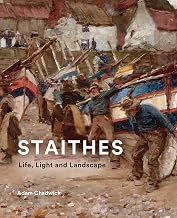
STAITHES : LIFE, LIGHT AND LANDSCAPE
By
Adam Chadwick
Kulturalis Ltd., 279 pages. £45. ISBN 978-1-83636-007-0
Reviewed by Jim Burns
Adam Chadwick, writing about the decline of places like Scarborough and
Whitby as ports and centres for commercial fishing, points to how the
development of the railway system, leading to increased tourism, provided
new sources of employment and income.
Smaller locations, such as Staithes, Runswick, and Robin Hood’s Bay,
however, tended to be left behind. As a consequence, “they remained
relatively unspoilt in comparison. Increasingly, they featured as desirable
destinations for middle-class visitors”, including artists attracted by the
opportunity to capture on canvas the lives, dress, and customs of the local
inhabitants.
There are interesting questions to be asked about why painters and others
chose to, in a sense, retreat from the “modern” world, with its urbanisation
and its towns and cities and their crowded streets. I recall some years ago
seeing an exhibition of paintings by the Glasgow Boys, and being struck by
the fact that, despite Glasgow’s status as a major industrial city, none of
the canvases on display gave an indication of a factory chimney, a dockside
scene, or a busy thoroughfare. It may, of course, have been a simple matter
of what the art market wanted. A rural landscape, or a colourful coastal
view, would have been more likely to have interested a potential buyer than
s picture of a tram trundling along a busy street. If I can put it in more
personal terms, my mother would have preferred a print or a postcard of a
country scene than one of the mining community she came from or the cotton
mill where she worked. It’s perfectly natural to want something pleasing to
look at.
Leaving all that aside, Staithes, the central subject of Chadwick’s
impressive book, was, for a time (roughly 1894 to 1909), a centre for
artists and photographers keen to capture what was a way of life that would
soon disappear. To be fair to the artists, their presence wasn’t just a
matter of commercial considerations. There was a reaction in the
late-nineteenth century to the dominance of what Chadwick refers to as an
“overbearing establishment” and the “Victorian notion of painting as
narrative and part of a ‘social mission’ ”. Many of the artists Chadwick
mentions had studied abroad, often in Paris at the Académie Julian but also
in Antwerp and elsewhere, so their horizons had been widened to take in new
techniques and ideas. They didn’t completely follow the latest trends from
the Continent, but rather adopted certain innovations to suit themselves and
used them alongside the disciplines they had been taught in art schools.
I
think It’s true to say that if there were influences from France they were
more often than not taken from artists like Bastien Lepage, Daubigny, and
the painters of the Barbizon School, as can be seen in William Gilbert
Foster’s “The Azure Mead” or Owen Bowen’s “Showery Haytime at Robin Hood’s
Bay”. There is also something to be said for pointing to the lessons learned
by Staithes painters who visited artists’ colonies in Holland, especially
Laren. The Hague School, as it was called, shared similar concerns in
wanting to portray the day-to-day experiences of the fishing communities.
All this springs to mind when I come across what must be one of the most
overused (and misused) terms, British Impressionists, in the lexicon of art
criticism.
Chadwick spends some time discussing the Staithes Arts Club, its members,
and its activities. It’s a useful exercise, though not all of the painters
associated with Staithes were members. A lot of those who were there, at one
time or another, were short-term visitors, particularly during the summer
months. But of those who were members, one who stands out, probably because
I’m reasonably familiar with some of his work, was Fred W. Jackson,
originally from Middleton in Lancashire. Chadwick says he was “the first Art
Club member to visit Staithes, Runswick Bay, and the surrounding area”.
His painting of Runswick Bay, reproduced in the book, shows him, as
Chadwick says, “at the height of his powers”.
It shouldn’t be forgotten that, as a professional painter, Jackson
had to take on less adventurous work to make money. Commissions for
portraits were always welcome, and town halls and galleries in Oldham and
Rochdale have their share of long-forgotten worthies. I’ve always been
amused by occasional ventures into town halls generally and their displays
of similar dignitaries.
Laura and Harold Knight were two of the better-known artists who lived in
Staithes, though they later moved to Newlyn to mix with painters there and
in Lamorna. Michael Cross, who wrote the introduction to the small catalogue
of a 1978 Fred Jackson exhibition in Rochdale, suggested that the Staithes
Group “lacked that vital Bohemian element which was a feature of its
counterpart in Cornwall, the Newlyn Group”. Chadwick contests this and
refers to a variety of activities to indicate that there was a lively social
scene among the artists. It’s difficult to know for sure, but from the
evidence he provides it did seem to centre around cricket matches, harmless
practical jokes, and polite get-togethers, as opposed to the sort of high
jinks often associated with artists. And the Arts Club appears to have been
a somewhat staid establishment. There was a little bit of scandal when Fred
Mayor and Hannah Hoyland eloped (her father had opposed her marriage to a
penniless artist) to France. Her “Still Life of Roses” is an attractive, if
conventional painting, whereas his watercolour, “A Staithes Fisherman”
is instructive of his observational skills. The man is more than a
face on a canvas. And there is the fascinating “Le Touquet, Paris Plage”,
which is almost all sky, and as Chadwick asserts, veers towards abstraction.
Fred Mayor, who suffered from asthma. died in 1916 and it makes one wonder
what he might have progressed to.
Going back to the Knights, there is little doubt that, during their time in
Staithes, Harold was the better artist. His “Herring Boats” is a splendid
picture of a crowded harbour with men busy on the boats, while his “Rough
Seas at Whitby” captures the drama of a “trawler-tug towing a sailing vessel
into port”. Laura, for her part, seemed to be feeling her way towards a
personal style. Her “Fishing Fleet” and “Packing Fish on the Quay” are both
good examples of life in Staithes, though perhaps still a little uneven in
terms of technique. But I do find her “Staithes”, with its view of “the
sharp descent into the Village”, appealing.
There is a later painting, “Spring” dating from 1916, and painted in
Cornwall and not Staithes, which is more accomplished. It looks almost
idyllic, with a rainbow over a country scene and two relaxed people to the
foreground of the canvas.. It’s
a curious picture and strikes me as somewhat contrived and more a product of
the imagination than any authentic scene.
I
referred to photographers earlier, and it’s a valuable aspect of Chadwick’s
book that it has information about some of those active in and around
Staithes. One of them, Frank Sutcliffe, had a photographic studio in Whitby,
where he carried out the usual commitments necessary to make a living, i.e.
portraits and the like. But he was much more adventurous, and one of his
photos, “Flag of Distress”, showing a ship that has run aground, has in its
composition some aspects of a painting. The same can be said of “Farmer and
Cart”, but the Sutcliffe photograph that really impressed me is “Trees in
Mist”. As Chadwick notes, it “turned a mundane subject into a prize-winning
exhibit at a Tokyo show in 1893”.
It invites attention. In a comment on Sutcliffe’s relationship to
art, Chadwick writes : “He was also only too aware of artistic techniques
and clear in his belief that artists had used his photographs. The visual
parallels that John Atkinson Grimshaw’s scenes of Whitby harbour by
moonlight bear to those of Sutcliffe, for instance, are only part of
extensive circumstantial evidence”.
Laura Knight is the female artist now most associated with Staithes, but she
wasn’t the only one active in that area in the 1890s and early-1900s. I’ve
mentioned Hannah Mayor, and Isa Jobling, from what I’ve seen of her work,
had the potential to be a significant painter. Her bright “Haymaking” makes
an impact immediately one looks at it. The combination of rural work, with
the sea in the distance, sums up life in and around Staithes.
Florence Hess “was introduced to
Runswick Bay by her teacher Mark Senior”, and became his good friend. Her
“Leeds Wharf”, though obviously not a Staithes painting, is striking and
indicates an awareness of industrial matters, whereas her “Sandsend Beck” is
clearly Staithes. A portrait of Hess was painted by Senior. Hess painted in
a variety of places over the years, and her work can be appealing to the
eye. There must have been other women among the many short-term visitors to
Staithes and Runswick Bay, and no doubt some of them produced paintings that
were never shown in public and no longer survive.
I
think I ought to mention Enid Pease Robinson
whose “illustrated diary….provides invaluable first-hand testimony
to the artists’ characters and social life”. Her caricatures of them playing
cricket and generally socialising are fascinating to see. Chadwick says that
“These sketches, many of which are published for the first time, explain why
Enid demurred, appended as they are with personal notes that flattered or
criticised her subjects”.
It
ought to be evident that life in Staithes, especially in winter, could be
less than comfortable. Chadwick refers to the well-known description by
Laura Knight of Fred Jackson painting outdoors : “Under the mittens he wore,
his hands were swollen, stiff and chapped, as were the edges of his ears and
the wings of his nostrils”. Norman Garstin, based in Cornwall, said
something similar when he remarked, that no painting could be considered
good “until you have caught a cold doing it”.
It was Garstin who painted the
wonderful “The Rain it Raineth Every Day” which showed Penzance when it was
wet. As for Staithes, or nearby, Fred Jackson’s “The Wheelhouse, Ellerby”
looks bleak enough with the bare branches of the trees against the dull sky.
There is so much in Staithes : Life, Light and Landscape I would have
liked to refer to that I was in danger of including just about everything.
It’s not dismissing earlier books on the Staithes Group to say that Adam
Chadwick has written what must be the definitive work on the subject. There
is a lot of new research in his book, and it takes in information about
photographers, in particular Frank Sutcliffe, and the comments and
caricatures from Enid Pease Robinson’s diary, not to mention the Staithes
Art Club. There are paintings I’ve never seen before. Andrew Colley’s “Old
Nab from Quarry Bank”, with people harvesting and the sea stretching to the
horizon in the background, stays in my mind. Mark Senior’s “Spring”, to
quote Chadwick, “not only captures the colour for which Senior is renowned
but also the movement that became a hallmark of his work”. There is John
Atkinson’s “Potato Pickers”, which brings out the back-breaking nature of
the work. I could carry on listing, but let me mention just one more
painting. Ernest Riggs’ “A Fireside Read” shows a young girl intent on the
book on her lap, with what I take to be her grandmother looking fondly down
at her. It’s perhaps what could be described as typically Victorian. I was
moved by it.
Staithes : Life, Light and Landscape
has
notes, a bibliography, and is profusely illustrated.