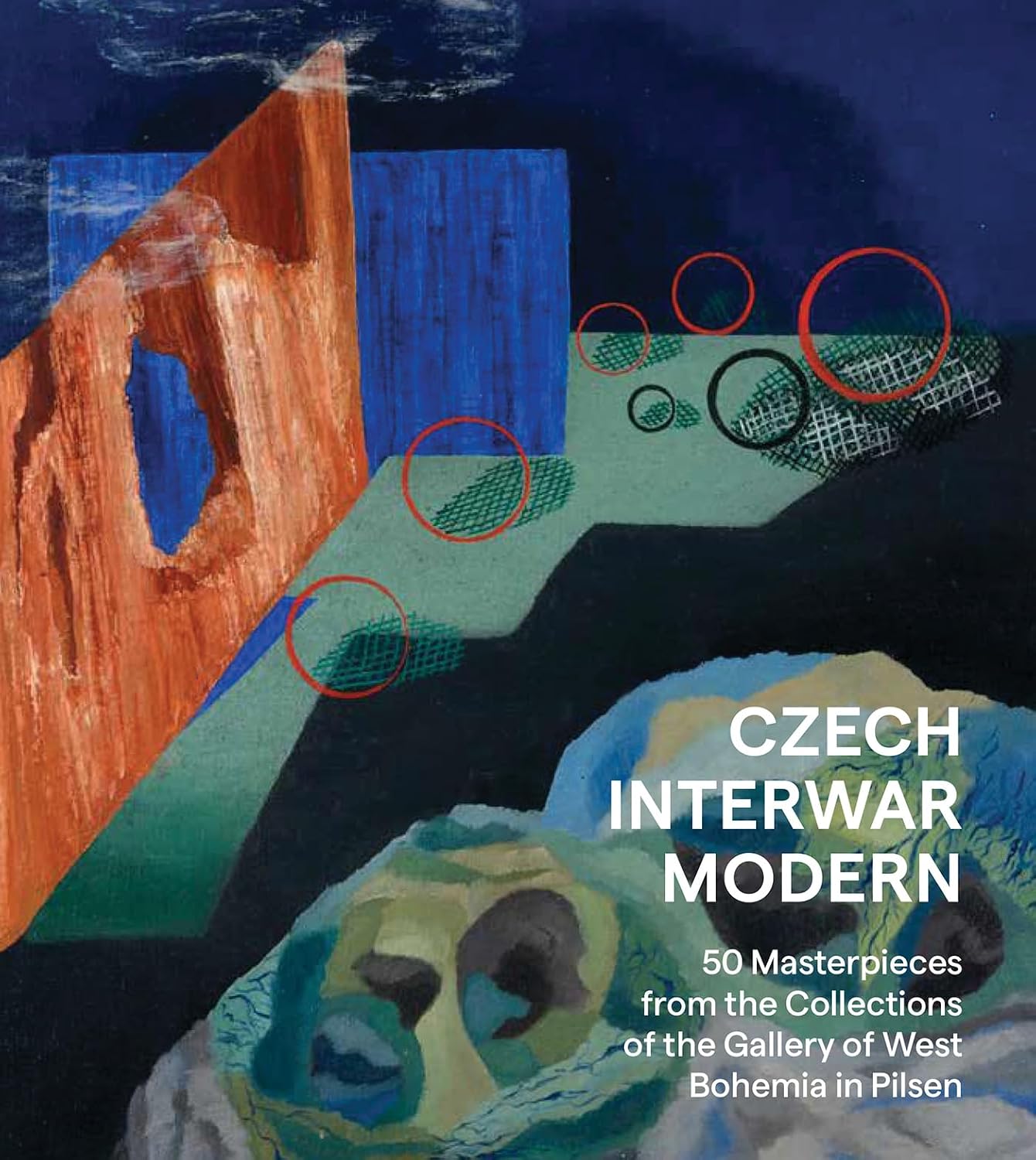
CZECH
INTERWAR MODERN : 50 MASTERPIECES FROM THE COLLECTION OF THE GALLERY OF WEST
BOHEMIA IN PILSEN
By
Roman Musil et al
Kulturalis. 120 pages. £14.99. ISBN 978-1-83636-046-9
Reviewed by Jim Burns
Czechoslovakia didn’t exist as an independent state until 1918 when the
Austro-Hungarian Empire collapsed at the end of the First World War. With the
advent of a new country came an enthusiasm for fresh forms of art, with young
artists able to look elsewhere to find out what had been happening in other
countries. Some Czech painters had been influenced by new developments in France
and Germany prior to 1914. Bohumil Kubišta had established links to Berlin and
the German Expressionists, and had also spent time in Paris, where he studied
the work of Old Masters such as Poussin and El Greco, but also admired paintings
by Cézanne and what the Cubists were doing. I have the catalogue for a 1993
Kubišta retrospective exhibition and it’s clear to see how Expressionism and
Cubism both influenced him. He unfortunately died during the 1918 influenza
pandemic, but Czech painters in the 1920s spoke of him with respect and learned
from his paintings.
Various
groups of artists and writers formed in Prague in the 1920s, one of the more
significant being the Devĕtsil arts association which was founded in 1920 with
Karel Teige, Vitĕslav Nezval and Jaroslav Seifert among its leading lights.
Initially, it “supported left-wing politics, looking with hope to the Bolshevik
Revolution to bring about a ‘new world’ and promoting ‘proletarian art’ “. But
after Teige had made a trip to Paris in 1922, “Devĕtsil underwent a fundamental
ideative shift and began to establish itself as a truly avant-garde association,
focusing on progressive European trends”. However, by the early-1930s, with
political and economic developments increasingly shaping attitudes, a Left Front
movement came to the fore. Devĕtsil closed down in 1931. There had been problems
among its members because Teige’s “adherence to party policy stifled Devĕtsil’s
intellectual and creative freedom and stirred up conflicts within the group”.
(I’m quoting from Breaking the Rules : The Printed Face of the
European Avant Garde 1900-1937 (British Library, 2007), which has an
interesting piece on Devĕtsil and its publications.
Surrealism was by then on the rise and a Czech Surrealist Group was formed in
1934, though it doesn’t seem to have lasted too long. Alena Pomajzlová, in her
essay about Czech Art in the 1920s and 1930s, says that, under Teige’s
leadership, “The Surrealist group itself eventually became a battleground where
clashes over artistic issues escalated into personal and political attacks by
radical left-wing members”. She adds
that Jindřich Štyrský and the intriguing Toyen (Marie Čermínová) “were the only
painters among the group’s members”. Both are represented in Czech Interwar
Modern, Štyrský with a “flat land motif with aquatic plants levitating on a
blue background and a hint of the shore receding into indistinct depths”, and
Toyan with “a view of a geometrically arranged exterior with a raised plane on
which various objects are placed”. It occurs to me to suggest that, should
anyone want to know more about this period, the best English-language source may
be Derek Sayer’s Prague, Capital of the Twentieth Century : A Surrealist
History. (Princeton University Press, 2013).
A
painter who crops up several times is Josef Šima, with Musil commenting that “To
a certain extent, it could be said that Josef Šima was to the younger generation
of artists establishing themselves in the interwar period what Bohumil Kobišta
was to the generation of Cubist artists”. Šima’s “Boats in a Harbour”, painted
in France, where he lived while keeping In regular touch with Prague, attracts
attention, and it’s said that his “images of Parisian steamboats are strikingly
similar in style. The flat compositions are built on a rectangular grid of
horizontal and vertical lines”. We are also told that Šima’s “emphasis on
composition, and the gradual simplification and reduction of forms led him to
abstraction in the mid-1920s, a style that was completely unique in Czech art at
the time”. An example of his abstract work may be “Blue Landscape”, though in a
way it might be difficult to pin it down with a one-word description : “a
horizon divides the picture plane into land and sky. In front of this horizon,
two green shapes and two grey-green shapes of an irregular form are floating,
casting shadows on the lower part of the picture representing land”.
It’s stated that Šima “refused to be
confined by stylistic boundaries or established programmes”.
It is,
I think, true to say that, despite the groups and “isms” sometimes referred to,
most of the artists didn’t necessarily adhere to their rules. There perhaps
wasn’t any one “specific artistic style” in evidence, and the phrase “a diverse
modernity” may be the most apt description when looking at the paintings in this
book. Josef Čapek’s “Man with a Stick and Sack” is almost cartoon-like in its
depiction of someone “on the margins of society”. Alfred Justitz’s “Female Nude
in a Hat” puts one in mind of Renoir : “The girl’s appearance, and in particular
the motif of the round yellow hat with a blue ribbon, are indeed reminiscent of
the French Impressionist’s work”.
There
are interesting questions raised by comparing two paintings, Karel Holan’s
“Night Company” and Milada Marešová’s “Prague Café”. In the former we are “in a
dimly-lit café or tavern, where a man and three scantily clad women sit around a
table in silent apathy, drinking alcohol”. It’s suggested that Holan was
familiar with the work of Edward Munch, but also that he was aware of German
Neue Sachlichkeit (New Objectivity), “which became prominent in Czech interwar
art during the 1920s”. In contrast, Marešová’s “Prague Café” shows the
bourgeoisie in comfortable surroundings, if not exactly happy. Marešová was “one
of the most prominent Czech female artists of the interwar period” and her
painting, with its seemingly isolated figures set against a red background is
striking: “Prague Café” is a “psychological study of the modern, alienated
individual”. Alienation is the common theme in both paintings.
There
is much more that I could refer to in this enlightening small volume. Karel
Boháćek’s “Cottages near Zamachy”, with the cottages in the distance and the
foreground of the painting taken up by “Fields of clay and their earthiness”,
Emil Fill’s “Still Life”, in which a “miniature world of everyday objects was a
metaphor for the universe”, and Václav Rabas’s “By Third Class from Kladno”,
with a “motif drawn from mundane, everyday life”. Czech Interwar Modern,
with each painting accompanied by informative analysis and commentary, is highly
recommended.