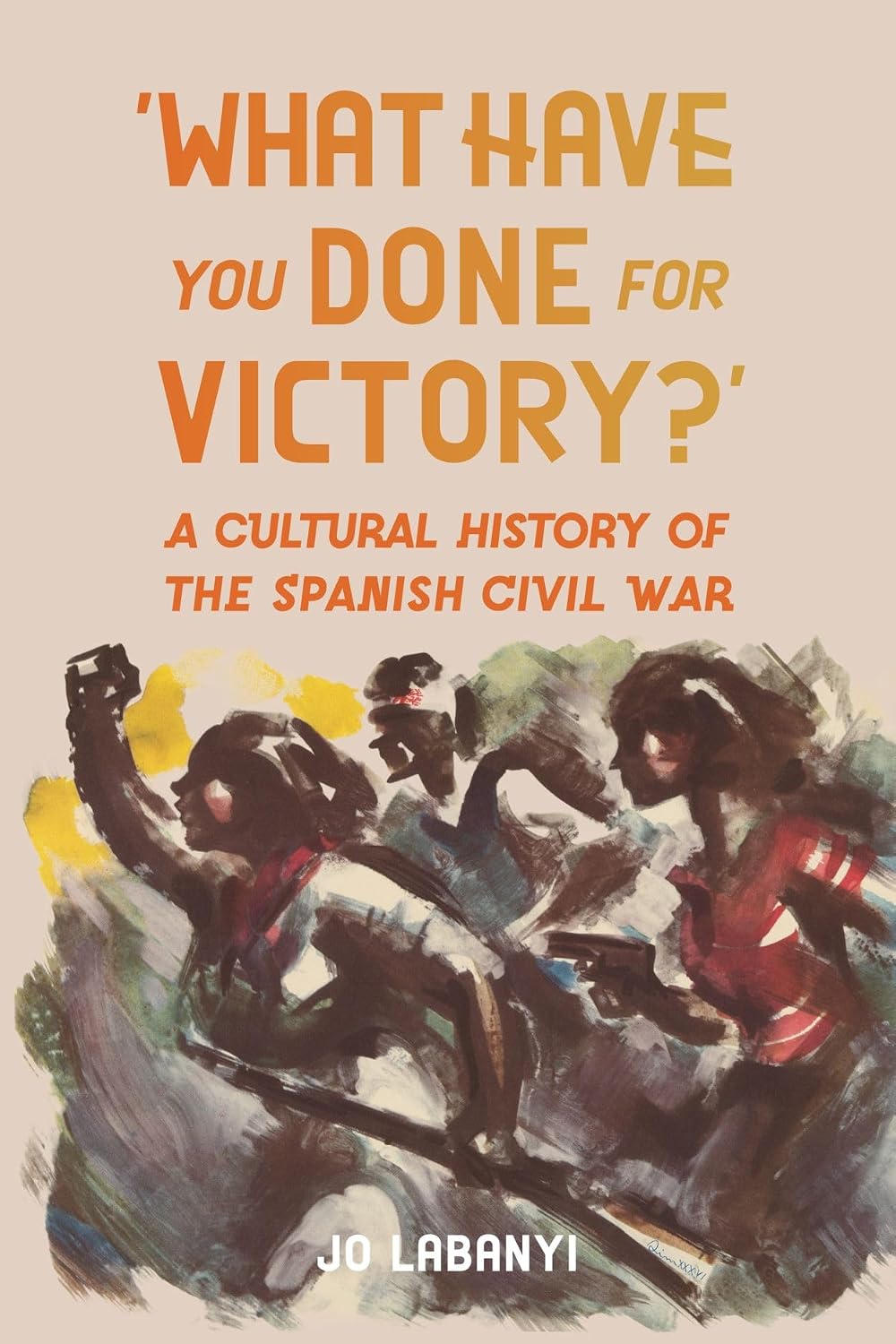
WHAT
HAVE YOU DONE FOR VICTORY? : A CULTURAL HISTORY OF THE SPANISH CIVIL WAR
By Jo
Labanyi
Reaktion Books. 503 pages. £29. ISBN 978-1-83639-278-1
Reviewed by Jim Burns
Books
about the Spanish Civil War are numerous, with most of them focusing on the
military and political struggles that took place between 1936 and 1939. Some do
make references to the cultural aspects of the conflict, such as films, novels,
poetry, posters, propaganda, music and more. But a whole book devoted to the
subject has long been needed. Jo Labanyi may well have produced such a book.
As she
says, “this was a war about which it was (and is) impossible to be indifferent”.
And she asserts that “The Spanish civil war represents the heyday and demise of
anarchism as a political project”. We are told that “communist discipline played
a major role in making the Republican army an efficient fighting force”. This is
not the place to provide an outline of military aspects of the war, but it is
essential to understand how the differences of opinion about why the war was
being fought underlined the way in which it was fought. The anarchists saw it as
an opportunity to bring about a social revolution in Spain, whereas the
Republican government, with some people suggesting that it was influenced by the
communists, took the view that defeating the Nationalists, as Franco’s forces
were called, was their top priority. Wider social and political changes, as
envisaged by the anarchists and if they were to take place, could come once
victory was achieved.
This
isn’t to suggest that the Government ministers were indifferent to certain basic
improvements. Programmes to improve literacy, especially in rural areas, were
introduced. New libraries were built. There were schemes to bring culture, in
the form of art, literature, theatre, and music, to wider audiences than had
previously been involved. The rigid class system that existed in Spain had
mostly limited appreciation of arts beyond the popular to an elite.
With this in mind, the People’s Theatre
and Choir took a programme of Spanish Golden Age drama and medieval ballads to
small towns and villages: “Golden Age theatre was deemed appropriate also
because it had played to audiences of all classes; only in the eighteenth
century did the theatrical divide set in. The medieval ballad tradition remained
vibrant in 1930s rural oral culture; the ‘missionaries’ told how their rural
audiences connected immediately with the ballads sung or recited, with a
villager sometimes intervening to recite a version of the ballad passed down in
the family”.
Along
with theatre, the People’s Museum commissioned artists to make actual-size
copies of paintings by Velasquez, El Greco and others which were then shown in
exhibitions in rural areas. Postcards of the originals were distributed freely
and talks on Spanish art were given. I’m compressing my account of what took
place, and Labanyi provides a much more detailed survey, which also includes
music and cinema.
Recitals of recorded music introduced rural audiences to both Spanish and
foreign composers, and gramophones and records were distributed to libraries. As
for the cinema, screenings were “run on generators since rural areas rarely had
electricity”, and were well received : “This is evident from the large number of
still photographs of rapt peasant audiences taken by the filmmakers who ran the
screenings”. It didn’t surprise me to learn that Charlie Chaplin comedies and
Felix the Cat cartoons were popular. As someone who grew up in an industrial
town in the 1940s, when the cinema was the main focus of entertainment, I spent
hours watching films and cartoons. They took me away from the world outside the
cinema.
Poetry
was something that anyone with access to a pencil and paper could create, and
the actual amount written during the Spanish Civil War is probably impossible to
quantify. It was obviously of varying standards and I would guess that little of
it has survived. There were, of course, published poets active in the ranks of
the Republicans whose work had lasting qualities. I have a book called Cries
From A Wounded Madrid : Poetry of the Spanish Civil War, edited by
Carlos Bauer (Swallow Press, 1984), which includes some of the poets Labanyi
discusses, such as Miguel Hernandez,
Rafael
Alberti, Vicente Aleixandre, and Antonio Machado. The latter’s poem, “The Crime
Took Place in Granada”, is about the murder by Nationalists of perhaps the
greatest Spanish poet of that period, Federico García Lorca. However, along with
the poetry that is still remembered, there were hundreds of poems contributed to
the “wall newspapers”, often established by individual regiments in the
Republican army and using poems, drawings, reports and other material to both
entertain and inform the troops. Obviously, the poems written for display would
not necessarily be more than functional in what they said and how they said it.
But they served their purpose at the time and, who knows, may well have done it
in a better way than some acknowledged poets could have done. Writing directly
for immediate use is not always easy.
I’m
looking ahead a little by bringing in at this point poetry about Spain written
by non-Spaniards. Labanyi refers to Auden’s “Spain”, which she describes as
“probably the most cited English-language poem on the Spanish civil war”, but
says that it is a “masterpiece of evasiveness, telling us little about the war
or Auden’s response to it”. Following a
brief analysis of the poem, she adds that “we are left with an overwhelming
negativity”. If this seems to be a harsh judgement, then look at Labanyi’s
verdict on Roy Campbell’s book-length poem, Flowering Rifle : A Poem from the
Battlefields of Spain. Campbell claimed to have fought for the Nationalists,
but the closest he ever got to the war was a day he spent as a journalist near
the front at Talavera. She says that, ”Flowering Rifle is perhaps the
most distasteful poem ever written”, pouring out a stream of invective against
Auden, Stephen Spender, the Bloomsbury Group, the International Brigades, Jews,
communists, and just about everything else he could think of.
Other
poets besides Auden, Spender and Campbell wrote about Spain, and among them was
the American Edwin Rolfe, whose poems I have always liked. He served in Spain
with the Abraham Lincoln Battalion of the Fifteenth International Brigade, and
his work has been reprinted in recent years. But on my desk as I write this
review is a little book, Salud : Poems, Stories and Sketches of Spain
by American Writers edited by Alan Calmer
(International
Publishers, 1938), with Rolfe’s poem “Elegy For Our Dead”. Also included is
James Neugass’s On the Road, about his experiences as an ambulance driver
in Spain. Labanyi discusses Neugass’s diary, War is Beautiful : An American
Ambulance Driver in the Spanish Civil War, which was only published in 2008.
It may
be that most people without a specialised knowledge of the war in Spain will be
familiar with some of the posters that were produced to highlight aspects of the
struggle to defeat Franco. Many emanated from the various unions and political
parties supporting the Republic, such as the anarchist FAI (Federatión
Anarchista Iberíca), the syndicalist CNT(Confederación Nacional de
Trabajadores), the socialist UGT (Unión General de Trabajadores), the
anti-Stalinist Marxist POUM (Partit Obrer d’Unificació Marxista), and the
communist PSUC (Partit Socialista Unificat Catalunya). It’s difficult to
describe posters without having them available to view, but Labanyi says they
covered topics like denouncing Nationalist air raids, education, saving art
treasures and, as indicated by the title of this book, encouraging the war
effort in various ways. There were also posters pointing to the dangers of
venereal diseases and the debilitating aspects of drunkenness. “A drunk is a
parasite. Out with Him!” proclaimed one illustrating a shady-looking character
with a cigarette hanging out of his mouth and obviously the worse for wear. One
of the more-striking posters, pictured in the book, is “Let’s Crush Fascism”
with a foot pressing down on a fractured swastika.
The
aftermath of the war saw numerous books about what happened in Spain, and
Labanyi does a decent job of surveying at least some of them. She is useful from
the point of looking at novels and memoirs written by Spanish authors,
particularly when the books haven’t been translated into English. However, most
readers of her book will probably focus on material in English, with Ernest
Hemingway’s novel For Whom the Bell Tolls and George Orwell’s factual
account, Homage to Catalonia, perhaps taking pride of place. Hemingway’s
book, published in 1940, was not well-received by some of the Americans who
fought in Spain, and Labanyi, while praising its literary qualities, draws
attention to various of its shortcomings in other directions. It tends to
glorify the role of Robert Jordan as an example of
American individualism, but “Nothing could be further from the ethos of
the Spanish Republic”, which stressed the importance of the collective. And the
peasants Jordan recruits to help him in his sabotage work do not seem to have
any feelings about where they stand politically; “Politics don’t enter their
conversations”. All this is odd, considering how steeped in politics the war in
Spain was.
With
regard to Orwell’s Homage to Catalonia, Labanyi points to some of its
limitations, such as its neglect of the contributions made by women to the war
effort. His wife, who was with him in Spain, and working in the Independent
Labour Party’s (ILP) office in Madrid, is barely mentioned and Labanyi says that
she saved him “from arrest or worse” when members of the POUM militia were being
rounded up. I don’t want to give an unbalanced summary of her account of
Homage to Catalonia, a work I admire, so I will refer to what she says about
aspects of the book. She makes it clear that “political analysis” was “his chief
concern in his account of his personal experiences”, and elsewhere she writes
approvingly about how Orwell saw the war with all its positive and negative
sides..
There
are several other memoirs that Labanyi considers. Esmond Romilly’s Boadilla,
which “recounts his experiences in the International Brigades’ Thaelmann
Battalion (to which the first British volunteers were assigned prior to the
British Battalion’s creation in January 1937), in which he enlisted as a
teenager in October 1936, cycling across France”. Labanyi says that “The book is
written as a tribute to the eighteen British members of the Thaelmann Battalion,
seven of whom died at the battle of Boadilla on 20 December 1936”. Romily left
the country in January 1937, suffering from dysentery, and never returned to
Spain. There is a brief reference to an anarchist manifesto, “The Organisation
of Indiscipline”, he came across and admired in Madrid.
The
curious memoir, A Moment of War, by Laurie Lee is given some attention,
largely because his claims to have fought in Spain at the battle of Teruel were
shown to have been false. He did go to Spain and joined the International
Brigades, but was never involved in any fighting. There is a marked contrast to
Alvah Bessie’s Men in Battle, published shortly after he returned to the
USA in late-1938. Bessie, a novelist, blacklisted Hollywood screenwriter, and
one-time member of the American Communist Party, did see action. Labanyi is
rightly positive about Bessie’s book. It’s also worth noting that he edited
Our Fight : Writings by Veterans of the Abraham Lincoln Brigade Spain 1936-1939,
published in 1987. One veteran who wasn’t included was William Herrick. He had
been a member of the Communist Party before going to Spain, where he was
wounded. But on his return, disillusioned by what he had seen and experienced,
he became notably anti-communist. His
Autobiography, Jumping the Line : The Adventures and Misadventures of
an American Radical (1998) is worth reading in connection with the Spanish
Civil War. It’s also worth looking at his novel, Hermanos! (1969) for its
portrayal of the clash between the anarchists and communists. Labanyi
doesn’t mention Herrick, but I feel he deserves some sort of recognition for his
individual stance.
I think
I ought to mention Peter Kemp’s Mine Were of Trouble, his memoir of the
war in Spain. Kemp served in the Spanish Foreign Legion, one of Franco’s key
units brought over from North Africa when the war started. It was comprised
largely of Spanish troops with foreign volunteers from Portugal, France, and
elsewhere, including a few from Britain. Not much has been written about them,
but Christopher Othen’s Franco’s International Brigades :
Adventurers, Fascists, and Christian Crusaders in the Spanish Civil War
(Hurst, 2013) provides a great deal of relevant information.
There
is so much more that makes What Have You Done For Victory? an essential
book for anyone interested in the Spanish Civil War, and in what took place
alongside the military operations. Labanyi has something to say about
documentaries like To Die in Madrid and The Spanish Earth but also
feature films such as the Hollywood version of For Whom The Bell Tolls
and the curious Blockade, starring Henry Fonda as an officer in…….well,
which army was he in? The film is
ambivalent about who is fighting who, though the viewer can guess that Fonda
might be a Republican. There is, of course, Ken Loach’s Land and Freedom,
with its obvious inclinations towards the POUM and anarchist militias, and its
portrayal of their suppression by the authorities when all such independent
units were incorporated into the Republican Army.
Have I
left anything out? Yes, John Dos Passos’ novel, Adventures of a Young Man,
written after he’d turned anti-communist because of the execution of his
friend, José Robles, and broken his friendship with Hemingway who refused to
condemn the action. Labanyi doesn’t mention Hemingway’s attitude.
But enough. No writer can cover
everything, though Jo Labanyi almost gets close to it. Her book is a mine of
information. There are forty pages of notes, and an extensive bibliography.