CLAGGART; OR, MICRO-FASCISM
The
problem of fascism has to be seen as
a problem of the “normal”
organisation
of our lived relations”[1]
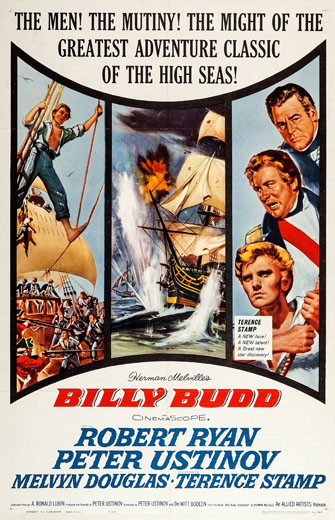
Set
in the immediate aftermath of a series of late C18th naval
mutinies at the onset of the Napoleonic Wars, Melville’s Billy Budd
reveals a character at a distinct remove from that more discussed character,
Bartleby. Whereas the latter seems to be will-less to the degree of offering
up a suspension of ego that can be read as an existential revolt, Claggart,
the master-at-arms of the Bellipotent, by contrast, incarnates not so
much the obsessively driven authoritarianism of Ahab, but a parasitic
accommodation to such power. If Bartleby and Ahab could be said to be at
opposite poles, if they can be philosophically genealogised, then Claggart
remains spookily in the backroom: “His portrait I essay, but shall never hit
it.”
Claggart seems to have come from nowhere and everywhere. His accent is
indistinct. His complexion, whilst pallid, has the unusual amber hue of the
“time-tinted marbles of old.” His past is a matter of surmise. He is not an
old sea dog who has spent a life at sea but one of those who belatedly chose
ship-bound work so as, it is conjectured, to seek sanctuary from the
ramifications of some “mysterious swindle” or monarchical plot in defiance
of the French Revolution. But even these half-verdicts, the narrator
suggests, sway unsteadily amidst a garrulous naivety that cloaks Claggart in
a harmless “vulgar rascality.”
Melville’s narrator seems to be suggesting there is something “wicked” about
Claggart that escapes his fellow sailors and that, in going either unnoticed
or unremarked upon by them, is maybe indicative of some tacit sense of
unquestionable masculinity. Claggart has stealthily made his way through the
ranks by means of “constitutional sobriety” (rational calculation), “an
ingratiating deference to superiors” (subservience) and a “ferreting genius”
(intelligence gathering). In highlighting and combining descriptors such as
these Melville is bringing to light characteristics that, whilst innocuous
in the work-a-day world, are nonetheless all factors in power-relations that
can come to resonate as elements of a ‘micro-fascism.’[2]
Unlike the begrudged yet fear-fuelled influence that Jackson wields over the
crew in Melville’s Redburn, Claggart’s schemings are more or less
immune from collective criticism. His sense of well-being and social
confidence is guaranteed not just by his personal position as a minor
official in the ship’s political structure, but is empowered by a clique of
subordinate and collusive corporals that are compliant “to a degree
inconsistent with entire moral volition.” Such an abdication, or suspension
of morals, enables Claggart and his, perhaps, wide-ranging cabal to work at
a clandestine level to foment the “mysterious discomfort” of other crew
members.
Whilst it is to Billy Budd’s tragic discomfort that Claggart works at most
assiduously, it should be borne in mind that for his racket to function he
must be trusted by his superiors. This is easy for Claggart in that he sides
with the ship’s officers not just because he is au fait with
hierarchic gradations but because the indicators we term ‘micro-fascist’
above are inconspicuous, taken for granted, and encouraged both on ship and
(as Melville analogically suggests on more than one occasion) in “business
departments.” They are necessary to sniff out “incipient trouble” before it
becomes recalcitrance, insubordination and mutiny.
So,
when it is suggested that Claggart is the “embodiment of radical evil,”[3]
we are led towards appraising the rattan-wielding Claggart (“zealous in his
function”) as being nothing more than a depraved individual who has a
“spontaneous antipathy” to the handsome sailor, the beauty, Billy Budd; he
of “innocent non-age.” However, there are clues that what could be at play
in this antipathy is not some metaphysical conundrum but a psychological
density, a malicious enjoyment, that confounds motive and emotion. That this
comes into play in the ‘drumhead court’ to which, through Claggart’s
machinations, Billy is eventually arraigned is no small matter. The
presiding judge, Captain Vere, foregoes such considerations and tellingly
rejects any need for “psychologic theologians” in arriving at his verdict.
The
narrator has already touched upon this indeterminate aspect: “Who in the
rainbow can draw the line where the violet tint ends and the orange tint
begins? Distinctly we see the difference of the colours, but where exactly
does the one first blindingly enter in to the other?” It could be inferred
from such a poetic sentence that Melville is hinting at that psychological
nuance, that field of unverbalisable affects and blurred feelings, that
elude easy intellectual inception but which subsist between Claggart and
Billy Budd; a portentous form of communication that is far more meaningful
than the insubstantial language that passes between them and which, however
sensed as “strange dubieties,” remain unuttered in court.
That Claggart has jovially flattered Billy on deck whilst simultaneously
grimacing in his presence, that he is depicted as being flirtatious and
light-handed towards Billy (the incident of the ‘spilled soup’) whilst also
being described as harbouring an obsessive “subterranean fire” is not lost
on Billy Budd, who, despite his being seen as a “man-child” blinded by
innocence, is struggling to form his intuitions into the more certain shape
of thoughts. To help orientate himself, to socialise his concerns and dampen
his nagging discomfort, Billy consults an older seaman, the Dansker.[4]
The response, as cryptic and non-committal as can be, is that Claggart is
“down on” Billy.
Hate ricocheting into its opposite? Affection shot-through with aggression?
The inference here, with the trope of the ‘handsome sailor’ prominent from
the outset, is that, naturally, Claggart has a crush on Billy. However
unsuspected this is to Billy his reaction infers an unconscious ‘knowledge’
in that he is described as finding the Dansker’s curt words as disturbing as
the mystery of Claggart’s seductive behaviour towards him. Billy’s inklings,
his unwitting participation in the field of affects between them, are not
neatly demarcated from the society-of-men that is the Bellipotent; a
society that Melville makes resplendent with a homo-erotic gaze of which
Billy is the group object and, as the embodiment of male beauty, its ideal.
The
feminisation of Billy, his ‘becoming-woman’ – or, we could say, the
rendering of Billy as a cliched phantasm of the male imagination –
is, on one level, an occlusion of homosexual desire. As with some theories
as to the rise of Nazism, this would be one means of opening up Claggart’s
“wicked” antipathy to Billy as one of repressed desire. However, the shared
idealisation of Billy discounts an explanation of Claggart’s plots against
him as being motivated by the dammed-up drives of homosexual panic. Rather,
with this novel, we are witness to what David Green has referred to as the
“soullessness of an all-male world;” one in which male-bonding is as much
cemented by consenting to the frisson of cruel power games as it is by an
automatic work ethic.
If
we solely relate to Fascism as a matter of molar politics at the level of
nations and states, as an economic formation that salvages
capitalist-democracy, as the rescinding of ‘rights’ by an oligarchic
executive, if we, as often occurs, relate to its acolytes as stupid and
lacking in intelligence (“fascism can never triumph as we are more clever”[5]),
then, we fail to take heed of the incipient and sub-rational psychic
mechanisms of a micro-fascism through which shifting allegiances, jockeying
for position and gaslighted othering, yield, for some, a form of pleasure
that, in seeming to be a ‘growing over’ [transcroissance] of
sexuality and gender, runs through many aspects of our capitalised everyday
lives. Worse, it is operative in the very areas in which we come together to
struggle against such indignities.
Theweleit is one writer who does not shy away from taking the thoughts and
feelings of avowed fascists seriously. Furnishing us with a quote that is
apposite to the ‘evil’ motivations of Claggart, he cites Auschwitz commander
Rudolf Höss recalling his
term in prison: “The attractive younger prisoners were much sought after as
‘beauties’: they were the objects of the most vicious battles and
intrigues.”[6]
Here we are not so much in the presence of homophobia as that of a sexuality
that is being ‘leaned on’ as the vehicle through which to conduct games of
rivalry and prestige, a vehicle in which sexual desire becomes transposed
into expressions of dominance. In prisons and in public schools, as well as
aboard the Bellipotent, what we have, even in the absence of women,
is a patriarchal idiom that is so replete with the frisson of power that it
cannot help but re-assert itself anew in any society-of-men.
So,
intrigues, rackets, cabals… are these not the ways and means of a
micro-fascism that subsist in the psychical interstices of politics and
business? Are these, when taken as modes of organisation, expressive of
nothing more progressive than competitive social relations? Billy Budd,
however naïve and Christlike he is interpreted to be, however much his
skillful dexterity in the rigging of the foremast pales before his ‘scantily
developed subjecthood’, is, above all a character who does not participate
in power games. As Melville writes: “to deal in double meanings and
insinuations of any sort was quite foreign to his nature.” Is it such power
games, and the surreptitious erotics they stimulate, that underpin the
unifying codes of this society of men? Is it Billy Budd’s inchoate refusal
of the pleasureable trappings of patriarchal power that so riles Claggart?
Another ready-to-hand schemer from classic literature is Shakespeare’s
Edmund: “A credulous father and a brother noble, whose nature is so far from
doing harms that he suspects none; on whose foolish honesty my practices
ride easy!”[7]
Here Edmund displays the rational cold-heartedness (“constitutional
sobriety”) of manipulative practices, that opportunist advantage-taking
which prides itself on strategic intelligence but yet ‘rides easy’ along the
lines of least resistance. The unsuspecting Billy Budd cannot recognise that
his being singled out and ‘othered’ by Claggart (as woman, as child, as
incorruptible) is maybe a result of his unspoken resistance to the
sexualisation of power that marks “the [micro] fascist potentialities in the
social organization of gender itself.”[8]
One
of the rites of such social organisation is witnessed by Billy soon after he
has been impressed from the Rights-of-Man to the Bellipotent;
and thus, it could be said, transferred from the safe haven of a ‘regicidal
republic’ to that of a ‘bellicose monarchy.’ Billy is present at the
flogging of a fellow sailor, one whose misdemeanour is slight (temporary
absence from his post), and he is horrified into “heightened alacrity” by
the sight of a back “gridironed with red welts” and the “dire expression” of
shame on the victim’s face. Such mutilation, as Theweleit leads us to
consider, not only breaches the body-ego for its straying adrift from the
masculine social ego, but “disempowers public morality” (the possibility of
collective resistance) in tautologically displaying the “uninhibited
self-expansion of the flogger.”[9]
There is pleasure to be gotten by means-of and under cover of the code.
Billy’s alarmed reaction is only natural as the public flogging is intended
to shock him and his fellow sailors into conscientious work and discipline
on board the ship. However, as Theweleit comments, this “sting of command,”
once received can be passed on to those “below.” As with Claggart’s rising
through the ranks, we see a defence against pain in the prospect of being in
a position to deliver the blow. A kind of libidinal banking: “the man with
the whip exchanges the pain he has suffered for a pleasure.”[10]
The shame need not be contained and mulled-over but ‘cashed-out’ later as a
pleasurable opportunity for the drives to be ‘amorally’ expressed with the
added justification that everyone should suffer: ressentiment
releases tension; not least the tension, in a society-of-men, that any one
among us, including oneself, may, through a reluctance to participate,
reveal how the abusive code of patriarchal power is a means of ensuring
pleasure.
Billy’s intense horror, then, puts him at a remove from the Bellipotent’s
social ego: one in which Claggart’s “retributive righteousness” towards
Billy and other crew members can have full range in that it is sanctioned by
a micro-fascist ‘rascality’ in which the passing-on of shame, the legitimacy
of vengeful feelings, callous backbiting as verbal flagellation, the
discharging of violent emotion etc. can all, while seeming to uphold the
group law, give rise to personalised fulfilment.[11]
There is some sense here of what Theweleit refers to as the “supplementary
external egos” of fascism: to ensure that self-preservation affords some
pleasure and does not remain as waged drudgery, then, one such as Claggart
needs to deposit his desire in the bank, an additional external drive, in
order to gain an interest without paying fees to the super-ego.[12]
The
interest Claggart exacts is extortionate, but, before arriving at the events
of the ‘drumhead court’ it should be stressed that what Melville brings to
light in this novel is not a power struggle in which Claggart seeks to
overthrow Captain Vere and lead a mutiny on behalf of other crew members.
Neither, as far as we know, does Claggart seek monetary gain, a material
profit or even tips. No, Claggart’s “inconceivable motive” is to attain a
jouissance beyond gender and sexuality but in full conformity to the
‘transcendent’ and mitigating patriarchal code. He does this via a form of
psy-ops that, at several removes from bullying, uses the social ego
generated by a society-of-men, its psychological undertow, its covert
vacuoles of frisson, as a means to engineer the potential demise of the
traitorous ‘sissy’ Billy Budd.
Claggart is well aware of that constant fear of an uprising that dwells
amongst the ship’s officers (they cannot utter the word ‘mutiny’) and uses
the latter’s field of affect to manipulate them into arraigning Billy Budd.
He has Billy visited by other sailors (presumably emissaries from his
corporals) who whisper vague statements into Billy Budd’s ear that leave him
surmising that these may well be indicators of a planned mutiny. Again,
Billy is uncertain as to any sure-fire meaning and refrains from both
snitching and consulting the Dansker. After a length of time, presumably to
monitor Billy’s reaction, Claggart reports this ‘incriminating’ encounter in
the rigging to Captain Vere where, as “an invented rumour of an imagined
misdemeanour,” it takes on a legal materiality. Claggart, presumably in full
knowledge of the Mutiny Act (and perhaps of the added pressures on Vere as a
member of an illustrious seafaring family) must be aware that the
consequences for Billy will be severe.
So,
Claggart’s intent towards Billy appears to be a murderous one and wielding
power by means of institutional and psychological proxies, he leaves it to
martial procedure to enact ‘his’ desire. It is almost as if Claggart’s
racket is functioning as a parallel power aboard the Bellipotent; one
that safeguards patriarchal freedoms. However, in terms of the eventual
outcome, it is crucial to mention that Billy, maybe true to his ‘sissy’
nature, is a fretful person. He is described as unable to conceal his
anxieties, he has a stutter, he is overly conscientious to the degree that
he becomes “heedful in all things” right down to the tidiness of his bunk
area. Billy, in tying to read the gestures and expressions of his shipmates
and in his looking to Captain Vere as a father figure, is, Melville infers,
vulnerable to those “vague threats” which, as ambient anxiety, have rendered
him hypervigilant.
This hypervigilance, a further refutation of Billy’s ‘scantily developed’
subjecthood, is an indicator of a sensitivity to his surroundings. His
stutter can be seen as a way that he reacts to the social pressures of a
‘soulless’ male world which, for Billy, is made acute by his inkling that he
has been singled out by Claggart. So, just as the stutterer can be seen as
suffering from a physiological speech defect, an “organic hesitancy” as
Melville describes it, there is also the far from negligible factor of the
stutterer being psychologically aware of the power-dynamics at work in
social relations. That his stutter comes over him in the formal setting of
the ‘drumhead court’ is, then, no surprise, and, struggling to express
himself, being rendered mute, being at odds to the male-code, he explodes in
a bodily abreaction, an ‘acting out,’ that sees him fatally punch Claggart.
This punch is seen as an inverse miracle, an act of unpremeditated and willess murder, that Melville couches in a kind of supernatural aura. Like Jesus on the cross, Billy is fated to be hung and just as it is noted that his body does not spasm on the point of death, there is a kind of ‘heavenly choir’ that becomes audible as his body is dispatched into the sea. Melville peppers a penultimate chapter with descriptions of environmental sound, a kind of entity music (“murmurous indistinctness […] not easily to be rendered verbal”), that adds a cosmic redemptiveness to the novel. However, as David Green offers, what comes across forcefully in this work is Melville’s intention to critique the homo social space of compulsory brotherhood, a society-of-men that in order to dominate seeks a rebirth (an ‘Eveless genesis’) by means of patriarchal structures that make power desirable. In other words, as Theweleit’s study of the fascist psyche demonstrates: “The problem originates in the relation between the world and the male ego: a power-relation in which pleasure is taken in violating whatever displays itself as living.”
Howard Slater
October 2025
[1]
Klaus Theweleit, Male Fantasies Volume 2, Polity Press 1989,
p.358.
[2]
See Félix
Guattari, ‘The Micro-Politics of Fascism’ in Molecular
Revolution: Psychiatry and Politics, Peregrine Books 1984.
Guattari expresses this in clear terms: “On the ground that the part
played by the individual in history is negligible we are advised to
stand idly by while local tyrants and bureaucrats of all sorts
perform their hysterical antics and paranoid double-dealings.” Ibid,
p.225.
[3]
Loren Goldner, Herman Melville – Between Charlemagne and the
Antemosaic Cosmic Man, Queequeg Publications, 2006, p.271.
Gilles Deleuze refers to Claggart as a “monomaniacal demon” in his
essay on Melville. See ‘Bartleby; or, the Formula’ in Essays
Critical and Clinical, Verso 1998
[4]
It is suggested by David Green that Billy’s “subjecthood is […] only
scantily developed”, which, aligns with a sense that Billy Budd is
not yet fully individuated, not yet born psychologically. This
interpretation may bring him close to the Bartleby character.
However, whereas the latter presents us with the question of social
ontology, Billy Budd, in his “innate repugnance to playing a part at
all approaching that of an informer against one’s own shipmates,”
shows a class-conscious sense of solidarity that is informed,
similarly, from a field of affects.
[5]
Summary dictum coined by Klaus Theweleit, ibid, p.261.
[6]
ibid, p.325.
[7]
Shakespeare, King Lear, Oxford University Press 1994, p.17.
[8]
David Green, ‘Flesh in the Word: Billy Budd, Compulsory
Homosociality, and the Uses of Queer Desire’ (2003) accessed at
https://www.colorado.edu/gendersarchive1998-2013/2003/03/01/flesh-word-billy-budd-sailor-compulsory-homosociality-and-uses-queer-desire
[9]
Theweleit, ibid, p.304. The latter citation is from Jean Amery’s
At The Mind’s Limit, Indiana University Press, 1980.
[10]
ibid, p.294.
[11]
Theweleit’s research into Fascist novels offers revenge as a key
factor in the right-wing psyche: “Fascism may not have offered
‘justice’ to the masses; but it did offer them the power to take
revenge.” Ibid, p.367.
[12]
The super-ego, the internalised moral injunction, is to a degree
externalised in the institution as a ‘social ego’; a move that
enables a collective abjuration of morality.