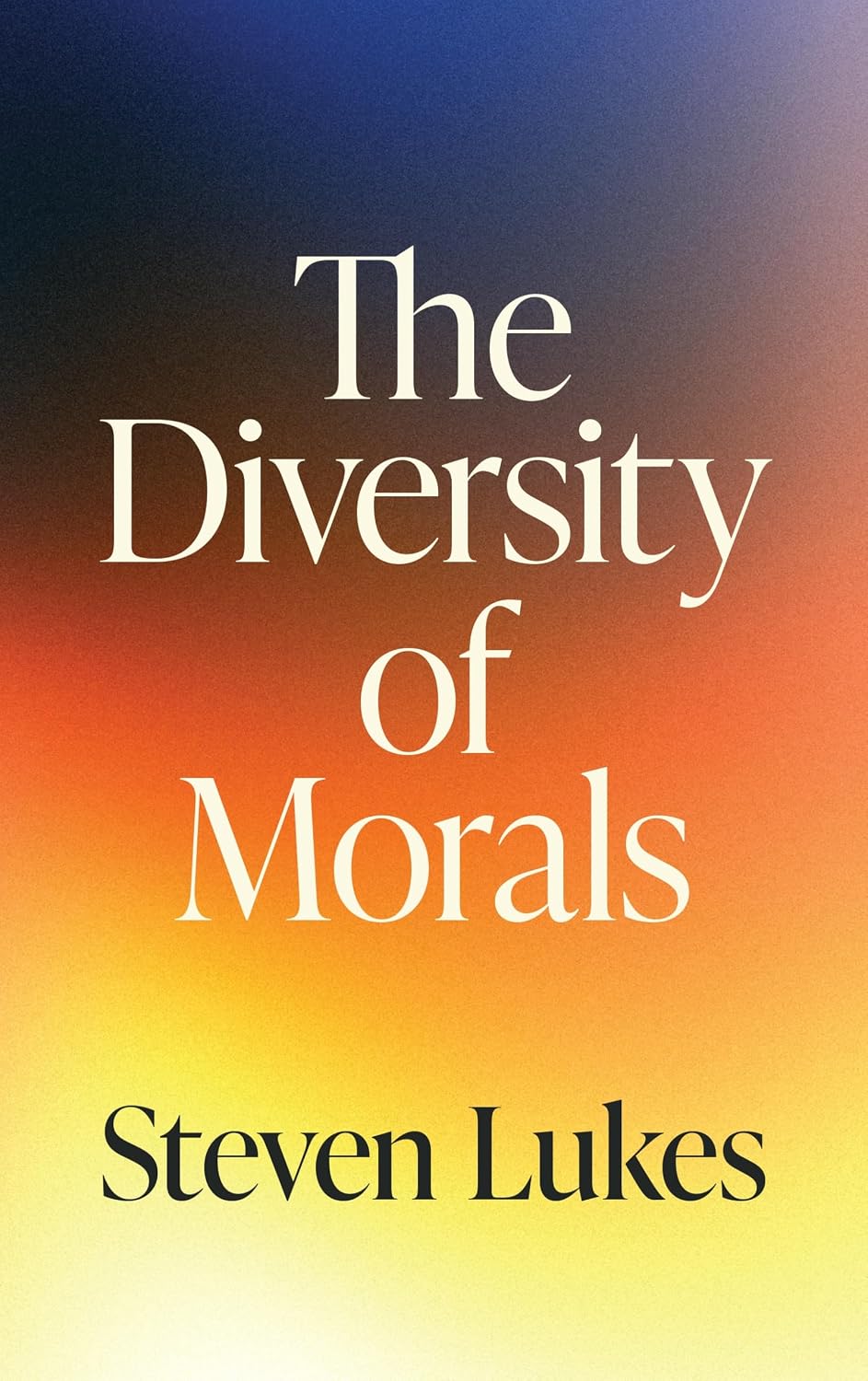
Steven Lukes, The Diversity of Morals
Princeton University Press. 256 pages. £25. ISBN 978-0-691-15719-1
Reviewed by Tony Roberts
A
few days before the American midterms I wrote to a friend: ‘I have just this
minute finished The Diversity of Morals which, although obviously a
book of limited interest to most, is in fact extremely interesting, very
well researched and carefully considered —though I doubt we're in a position
to learn from it. Too many vested interests. I should refer back to Susan
Neiman's comment I used to start my review of her Call It Evil [see
my NRB review of 10/26]: “The threat to morality today is less our
consciousness of its diversity than the growing consensus that it is a
sucker’s game.”’
The
undeterred Steven Lukes is now professor emeritus of sociology at New York
University. He wrote a chapter on ‘The Diversity of Morals’ in his 2008
book, Moral Relativism, which began with a quote from the sociologist
Morris Ginsberg; ‘To determine the extent and the nature of diversity in
moral judgments is a matter which presents great difficulties.’ With The
Diversity of Morals he seizes the nettle firmly, bringing together
considerable sources to engage with his observations. The book flap reads in
part: ‘Drawing on philosophy, sociology, social anthropology, psychology,
and political theory, Lukes considers what the moral domain includes and
what it excludes; how what is moral differs from what is conventional or
customary in different contexts; where the morality is unified or a series
of fragments; and, if there is a diversity of models, what the diversity
consists of.’
His
new cast includes starry names in the moral philosophy firmament: the
Ancients, Hume and Herder, Nietzsche, Max Weber, Isaiah Berlin, Raymond
Williams, Thomas Nagel, those philosophers portrayed in Metaphysical
Animals (Elizabeth Anscombe, Philippa Foot, Mary Midgley and Iris
Murdoch), plus Michael Walzer, Richard Rorty, Naomi Klein and many other
luminaries in the other disciplines mentioned. To support his argument(s),
he makes prodigious use of references to research data, including the
insightful and the notorious (the latter including those cartoonish ‘trolley
problem’ thought experiments and the flawed studies in behaviour control).
The
‘Introduction’ opens with central quotations from two schools of thought on
the subject of moral diversity. The first, from David Hume (1748) begins,
‘Mankind are so much the same, in all times and places, that history informs
us of nothing new or strange in this particular.’ The second is from Johann
Gottfried von Herder (1774): ‘Mother Nature has put tendencies toward
diversity into our hearts; she has placed part of the diversity in a close
circle around us; she has restricted man’s view that by force of habit the
circle becomes a horizon’. These contrary positions have long traditions
(the first, ‘nomothetic’, the second ‘ideographic’). The author tells us
that they have ‘broadly divided the social sciences from one another, with
psychology and economics usually taking the Humean side and history,
sometimes sociology and especially anthropology often inclining to the
Herderian.’
Lukes’ chapter on ‘The Demarcation Problem’ looks at whether there is ‘a
universal, species-wide human core of moral life that constitutes the basis
for the diversity we observe and experience.’ First, he addresses the
boundaries of the term, ‘moral’. He is concerned with the sense of taking a
moral position: ‘The moral standpoint … is where justification
occurs, to which judgments made from other standpoints are, in turn,
subject’. Drawing on the work of Boltanski and Thévenot (On Justification)
on orders of worth, he reinforces the term ‘to suggest that knowledge is
situated: that how people understand the world depends on the relations
in which they stand to it.’
One
possible cause of confusion he discusses is as follows:
If we accept ‘morality’ as concerning certain codes of conduct that
are adopted by an individual, group or society at large, we might find that
it is still not possible to get universal endorsement for it from all
rational persons, since standpoints can conflict (e.g. from religious
positions, on subjects like abortion or the death penalty). This problem is
compounded by the fact that different countries value individuality and
community differently. Another study he cites reveals differences in the
language we use to discuss such things. While terms like ‘good’ and ‘bad’
are universal, apparently, ‘“right” and “wrong” are English words without
equivalents in other European languages’[My on-line German dictionary gives
me ‘falsch’ or ‘nicht richtig’ for ‘wrong’.]
From a study of linguistic usage, Lukes sums up what seems to be included
and excluded by the idea of the moral domain. There are norms of behaviours,
he argues, which ‘make demands that in some sense’ we ‘recognise as such’,
which are different, for instance, from commands backed by force. Turning to
scepticism, he acknowledges that sceptics often hold the view that ‘all
moral talk involves, in particular, the illusion that moral considerations
have some independent, objective, and eternal justification or authority’.
Here he invokes Marx and Engels on ‘bourgeois prejudices’ and ‘Nietzsche,
morality’s most corrosive modern denouncer, [who] viewed morality as the
choice weapon of the weak enabling the slaves, aided by the priests, to
vanquish the strong’.
Bernard Williams, a leading moral philosopher of our time, agreed, seeing
morality as ‘a peculiar institution’ that should be treated with ‘a special
scepticism’. Yet Lukes counters with the argument that each of the above
‘unmask and debunk what they call morality from their respective moral
points of view —or, to use the language of “ethics,” all these skeptical
“meta-ethical” positions turn out to express first-order normative ethical
ones.’ (This is reminiscent of the Christian argument that all unbelievers
are so, in Christian terms.) We cannot climb out of the box: ‘The
moral is an irreducible and ineliminable aspect or institution of life and
every attempt to reject or escape its demands is just another instance or
expression of it.’ This is the ‘Bootstrapping’ argument—as in: we can’t lift
ourselves up by our bootlaces.
Lukes addresses one more attempt to avoid ‘demarcating’ the moral: by
assuming it has no boundaries but is itself an attitude to the world, though
this falls foul of the fact that we do understand what others mean by the
term.
In
‘Social Morals, Critical Morals’ Lukes looks to whether a scientific
approach might solve the demarcation issue. He considers evolution, in order
to find what is distinctive about human morality. To Darwin the moral sense
(or conscience) distinguished man from the ‘lower animals’. While some deny
animals morality on the grounds it would require reflectivity and ‘normative
self-government’ (Christine Korsgaard), others like primatologist Frans de
Waal, who considers animals as ‘proto-moral’, deny a clear break between
them and humans. What comes out of this is a distinguishing feature of man’s
relations with his fellow man: ‘the reciprocal recognition involved in
interpersonal interaction’ with authority, accountability, etc.
This leads —via discussion of morals versus manners, and borrowings from the
thoughts of psychologists and philosophers on the inner lives of others — to
Lukes’ assertion that ‘the critical dimension of morals stems from
rationality, understood as the capacity’ to challenge the value of our
beliefs and actions, to enlarge them. This ‘opens up the possibility of
social critique: of moving beyond local norms and to embracing the
universally human’.
How
and when did it happen that the moral universe expanded? Lukes turns to the
controversial notion of the Axial Age, a term invented by Karl Jaspers in
1949 and applied to common changes to religious and philosophical thought
occurring from the eighth to the third centuries BCE (in Persia, India,
China and the Greco-Roman world). These took the form of a questioning of
the old certainties that, according to Charles Taylor, people were simply
‘embedded in society, society in the cosmos, and the cosmos incorporated the
divine’.
What is important to Lukes’s argument is the notion here of ‘critical
reflection’. The idea of human dignity for all came later. For this,
a universalising recognition was necessary. He pursues the notion of a
secular sacredness through consideration of philosophical (Kantian) and
religious positions and on to Émile Durkheim. Durkheim wrote of a kind of
individualism which is central to the author’s ‘critical morals’: ‘the
glorification, not of the self but of the individual in general,’ whose
motive force was ‘not egoism but sympathy for all that is human'.
In sum, the chapter identifies the distinctively human quality of
empathy as the recognisable but much embattled core of moral life,
subject as ever to the dehumanising forces of social inequality.
‘Mass Atrocities’ concerns a real threat to moral universalism. What
interests Lukes is what people might do at such times to resist the coercive
atmosphere. He turns to three controversial experiments which seem to show
the fascist heart of man but which, in each case, seems greatly weakened by
inconsistencies: Stanley Milgram’s Yale University experiment (1961-2),
which involved ‘teachers’ administering electric shocks to ‘students’;
Philip Zimbardo’s Stanford prison experiment with ‘guards’ and ‘prisoners’;
and Darley and Batson’s Princeton Theological Seminary Experiment, which
tested the Good Samaritans among the students. He also considers
‘perpetrator literature’: Christopher Browning’s Ordinary Men, a book
about ‘how a few hundred Hamburg working class men enlisted in Reserve
Police Battalion 101 engaged in mass killing and roundups of Jews.’
Explaining this last seems to me more problematic than the student
experiments, though it no more proves that we are all potentially genocidal
than those people who risked everything to hide Jews during WW11 suggest we
are all saintly. Granted, in certain situations we are all capable of
changed behaviour—war being the obvious example— but our imaginations cannot
really take us there as ourselves. The Hamburg killers had their own
life experiences. If we were to put ourselves in their place, ‘Then, you or
I, we would have been someone else’ (Abram de Swaan 2015). The point is that
we have complex identities and our motivations are multi-layered (Knittel et
al 2018). Lukes further points out (after Hannah Arendt) that Nazi
perpetrators admired their genocidal actions, which they publicised as
‘historic’ and ‘grandiose’. This certainly suggests a diversity of values.
The
chapter on ‘Value Pluralism’ —a term popularised by the inspirational Sir
Isaiah Berlin — explores both the ‘width and depth’ of moral diversity. He
begins: ‘I shall seek to show, although both were liberal thinkers, Berlin’s
version is committed to an idea of moral progress while [Max]Weber’s is, by
contrast, bleak and Nietzschean. This comparison, I shall claim, suggests
two distinct ways of viewing the range and depth of the diversity of
values.’ In a fascinating section, Lukes goes on to contrast the idea of the
two thinkers: Berlin’s Cold War optimism versus Weber’s thoughts among the
wreckage of WW1 (‘a wider conception’ that included ‘evil in the name of an
apparent good’).
Looking into research into values across the world Lukes notes that social
behaviour cannot simply be explained by what people say about what they
believe or do. What is less obvious is that evidence suggests the diversity
of morals is greater than the diversity of values, both within and across
nations. Lukes refers to child rearing as one example. Japanese and American
educators approach the matter from different positions, but share the same
ends. He concludes that problems arise within diversity, when positions are
not susceptible to conciliation.
In
his ‘Conclusion’ the author considers just how intractable ‘value conflicts’
have become in a time of political polarisation. He quotes the late American
anthropologist Clifford Geertz who wrote of ‘the danger that our perceptions
will be dulled, our intellects constricted, and our sympathies narrowed by
the overlearned and overvalued acceptance of our own society.’ And then he
returns to the views he expressed at the outset by Hume and Herder, in order
to reconcile their positions (Hume’s ‘universal principles of human nature’
and Herder’s ‘tendencies towards diversity’). Lukes concludes, ‘Whether we
say that morals are diverse and, if so, to what extent…depends on how you
look at the question: where you are looking from, what you’re looking
for, and what you’re looking at.’
In
a ‘Coda’, he writes of the ‘apparent fragility of the liberal democracy’
which he sees undermined by ‘the deepening of moral conflict’, especially
with regard to religious zeal. We are further polarised by
‘hyperconnectivity’ so that the private sphere is dwindling as a consequence
of social media (our ‘private eco systems’). Problematically, people are
increasingly given to ‘shift their views to align with their party identity’
and rhetoric fashions moral outrage. Everyone is up in arms, or assumes
others to be: ‘Information is evaluated based not on conformity to common
standards of evidence or correspondence to a common understanding of the
world, but on whether it supports the tribe’s values and goals and is
vouchsafed by rival leaders.’ (David Roberts, 2017). He cites journalist
Ezra Klein (2020), ‘Sorting has made the Democrats into a coalition of
difference and driven Republicans further into sameness’. This, as Lukes
observes, is partly the result of ‘politically generated messaging’ from
those sinister elites.
However, we may yet hope to reconcile Herder with Hume, Weber with Berlin.
The sociologist Arlie Hochschild pointed out that Democrats and Republicans
share more views than they are aware of. And here Lukes offers hope —the
author sees positive signs in the ‘deliberative polling model’ organised by
the political scientist James Fishkin and others as a ‘national field
experiment in deliberation’, where people with opposite views are brought
together for evidence-based discussion. The results have been promising. It
is this view of the potential for shared understanding that Steven Lukes
leaves us with at the end of his rigorously reasoned, The Diversity of
Morals.
And
then came the mid-terms.