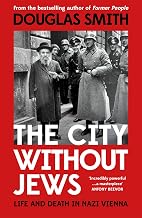
The City Without Jews: Life and Death in Nazi Vienna
Picador. 2026. £30. 560 pages. ISBN 978-1529090864
Reviewed by Tony Roberts
‘Why this is hell, nor am I out of it.’
(Doctor Faustus)
The
City Without Jews
is a
remarkable, important and relentlessly terrifying account of the Jewish
experience in Vienna from 1938 to 1945, the years in which they endured abuse,
desperately sought emigration, or suffered deportation. It is a testament to the
courage and memory of these victims of the brutality of the Austrian Nazis and
their supporters in the community. It is also the detailed, agonising story of
one Jewish family caught up in this horror and especially of one witness, Mignon
Langnas. Despite her sufferings, her exemplary dedication to others proved
little short of saintly.
The
author takes his title from a tragically prescient novel by the controversial
author and liberal publisher, Hugo Bettauer, assassinated in 1925 when, ‘The
Nazis killed the first Jew in Vienna.’ Just as Richard J. Evans’s The Third
Reich in Power revealed in detail how the Nazis took over German
institutions and German minds, so in The City Without Jews Smith
shows how Nazi mentality suborned Vienna, unleashing its native anti-Semitism.
While Evans’s book uses first-hand testimony from many voices, Smith has been
able to focus more specifically on the extended family of Mignon Langnas (née
Rottenberg): the Hausers, Langnases and the Ecksteins.
Originally from Galicia, Mignon’s family came to Vienna in 1914. She married Leo
Langnas in 1928 and the couple had two children, Manuela and Georg. After the
Anschluss (the annexation of Austria) in 1938 she refused to leave Vienna,
in order to look after her ailing parents, while the children and her husband
escaped eventually to New York City. Smith’s book, using Mignon’s diary and
letters, paints a nightmarish picture of life in the city throughout the war.
Living dangerously as a Jew in this violently anti-Semitic city, she trained as
a nurse, working firstly at a Jewish retirement home and then from 1942 at the
Jewish Children’s Hospital. At the cost of her health, she worked tirelessly
under the greatest of privations, always in fear for her life and uncertain of
her family’s welfare.
In a
relatively liberal period after the 1848 revolutions, Emperor Franz Joseph 1 had
moved to recognise the rights of Jews as citizens. In 1852 their community in
Vienna was legally recognised when the Israelitische Kultusgemeinde came
into existence. This ‘Israelite Religious Community’ (the IKG) was officially
recognised in 1890 as the representative body for Jewish affairs.
Self-governing, it became responsible for the needs, revenues and records of its
people. By the end of the emperor’s reign in 1916, Vienna had the second largest
Jewish population in Europe (after Warsaw), its numbers approaching 200,000, ten
percent of the city’s population. Jews made a very significant contribution to
the artistic and scientific culture of the times.
Anti-Semitism, however, had never been silenced and the dark mood of the times
was caught by, among others, the Jewish writers Arthur Schnitzler and Karl
Kraus. The city, like the empire, was multi-ethnic and multinational (a third of
its workers spoke Czech). Karl Lueger, mayor from 1897 to 1910, had achieved his
popularity partly from his publicly pronounced anti-Semitism. Towards the end of
Lueger’s term of office, a young Adolf Hitler made his appearance in the city,
where he failed repeatedly and found his virulent hatred of the Jews.
Many in
Austria longed for unification with Germany. After the 1914-18 War, the country
declared itself the Republic of German-Austria. The Allies forbade that.
Instead, a precarious First Austrian Republic came into being, despite early
attempts to overthrow it by Austrian communists. The Jews were widely blamed for
the war and suffered as a consequence, both then and during the Great
Depression. In 1932 Engelbert Dollfuss became Chancellor of Austria, ending the
republic with his one-party brand of fascism and outlawing the growing Austrian
Nazi party. He was murdered that year by the local SS. The new chancellor, Kurt
von Schuschnigg, had the impossible task of asserting Austria’s independence
from Germany and supporting the Jews, while simultaneously appeasing the
anti-Semites.
By the
middle of the 1930s the Jewish population of Vienna (approximately 191,000)
accounted for 60% of its lawyers, almost half of the doctors and most newspaper
editors and furniture store owners. But times were hard for the pro-German
population at large. The Nazis were an economic success story with an ideology
they envied. In the next few years Vienna would become, in the author’s words,
‘a laboratory for the Holocaust’. He quotes the Austrian historian Gerhard Botz:
‘The anti-Semitism in Vienna was more intense than that in the Old Reich. In
consequence, from 1938 on Vienna was always a few steps ahead of Germany in the
process of persecution of the Jews. Not only were the comparable measures
applied earlier in Vienna than in Germany, but they could also count on much
broader support among the non-Jewish population.’
One
indication of the state of affairs comes from a saying popular in Vienna during
the war: ‘The Germans make terrific Nazis but lousy anti-Semites, the Austrians
make lousy Nazis but terrific anti-Semites.’ As the moral philosopher Susan
Neiman pointed out, even the Nazis appealed to the population to view their
actions as being for the good of the community. Years of propaganda, envy
and scapegoating had conditioned both populations. (There were, of course —as
there always are —those who were not anti-Semites, those who showed kindness,
and those who protected victims.)
When
Chancellor Schuschnigg, in response to Hitler’s threats, attempted to hold a
plebiscite to register the country’s desire for independence, it prompted an
invasion. The Anschluss resulted from an internal uprising by Austrian
Nazis as well as the arrival of German troops. On March 13, 1938, Austria became
a largely willing part of the Third Reich.
The
playwright Carl Zuckmayer recalled that on the eve of the Anschluss,
‘What was unleashed upon Vienna was a torrent of envy, jealousy, bitterness,
blind, malignant craving for revenge. All better instincts were silenced.’ The
non-Jewish inhabitants of the city turned on the Jews. The theft of property,
beatings, humiliations became the norm, as did mass arrests. Soon businesses and
then homes were stolen, their occupants driven on the streets (‘Austrians were
seizing the Jews’ property on a scale, and with a speed, unimaginable’). Smith
gives detailed instances of these. As a New York Times reporter wrote at
the time, ‘Old Vienna is dead.’
‘On
April 26, the Viennese edition of Völkischer Beobachter, the Nazi Party’s
official daily newspaper, weighed in on the matter of Aryanization in an article
titled “How Will We however, match the zeal of the Austrian population.
Adolf
Eichmann, thirty-two years old, had been put in charge of Jewish affairs in the
city. It is instructive to read that this Nazi, whose ruthlessness political
theorist Hannah Arendt underestimated as unthinking, was in reality viciously
pragmatic in his role. He arrested senior figures of the IKG, nominated Josef
Löwenherz to be their leader, and demanded he provide a plan to ensure 20,000
poor Jews left Austria within a year. Smith writes, ‘Eichmann understood that,
along with violence, control over the Jews required psychological manipulation,
leaving them guessing’ as to his plans.
Soon
the Jewish question would be addressed by a pattern of orchestrated and
spontaneous outbursts of violence against its community. Then the
Nazis needed to curb the violence of
citizens, to protect ‘the theft of Jewish property intended for the state’.
Along with theft, came the increasing reduction of rights, enforced emigration
and later deportation. Löwenherz (and others), who had to deal with the plans
and whims of the Nazi hierarchy, would eventually be accused of collaboration.
In truth, his commitment to his community seems to have been steadfast.
Initially, in order to facilitate emigration, Löwenherz obtained Eichmann’s
approval to establish a Central Agency for Jewish Emigration, a single office to
deal with the tangled bureaucracy. For thousands of fortunate Jews it meant
survival; for the Nazis it meant reducing a despised population, while at the
same time stealing whatever it had left.
Kristallnacht
(the organised pogrom resulting from the assassination of a German diplomat in
Paris) occurred in early November 1938. It was felt more harshly in Vienna than
in Germany. Synagogues and shops were demolished, nearly eight thousand Jews
arrested and people thrown out of their homes. The following year more
restrictions came into force, including resettlement within the city.
The IKG
had organised the emigration of 63,351 Jews that year. It also had
responsibility for the 60,000 remaining. Almost half of these were in need of
living support. Yet from the outbreak of the war monthly aid had begun to
dwindle alarmingly. By the summer of 1941 —at the time of the invasion of the
Soviet Union — the number of Jews in Vienna had dropped to forty-four thousand.
The IKG
officials had no part in formulating plans and could do very little to mitigate
them. (That little included removing Mignon Langnas’s and her father’s names
from the deportation lists, doubtless in view of her value as a nurse). While
emigration continued to save lives, at the same time deportations became a
feature of Jewish life in Vienna. It would soon become apparent that the IKG
were being told lies about the designated ‘resettlement’ in Poland in the area
called the General Government. A meeting with Eichmann in February 1941,
according to the author, ‘marked a turning point for the IKG: inadvertently and
unwittingly, its function changed that day from saving Jews to aiding in their
destruction.’ By the following year the news of what would happen to the
deported had spread through Vienna.
With
the entrance of the USA into the war in December 1941 links with Austria were
cut; emigration ceased officially and the Nazis focused instead on their
transports to the East. Hitler soon gave the ‘elimination’ of Jews in Vienna top
priority, ‘since in Vienna there is only perfunctory whining’. By October the
population had been reduced to just under 8,000, mostly constituting couples
with Aryan spouses. The IKG had been closed and the city designated as free of
Jews.
On
November 28, 1942, Mignon, often ill and despairing, wrote to her cousin Hala in
Switzerland: ‘I have been so worn by hoping that it has become torture. I no
longer want to live on eternal “miracles” + “mercies”! I want peace at last. Oh
Halinka! I want to have my children again + a home + I long ardently for the
warm feeling of security. Will I experience it?’ Her nursing and her longing had
become her painful life.
Ironically, in summer 1944 when Hitler occupied Hungary — wavering in its
support for the war —nearly half a million Hungarian Jews were deported.
Eighteen thousand arrived in Vienna, the city applauded for its claim to be free
of Jews. By this time life there had become dangerous for everyone. Allied
bombers increasingly descended upon it. Many of the streets had been destroyed,
or been given over to rats and corpses. The black market thrived; people lived
much of the time in basements. Everyone went hungry. The Jews with their marked
ration cards could get very little to eat.
The
last train of deportees left Vienna in March 1945. The Russians arrived in
mid-April, which led to ‘liberation’ and more suffering, especially for the
women. The Third Reich had collapsed. In all, almost fifty thousand Jews had
been deported since the war began, of which only two thousand survived. In the
dying days of the Reich some Jews finally met with their first acts of
(self-serving) kindness from the population. This they knew to be Eine
Rückversicherung (a reinsurance), an alibi for when the Allies arrived.
I have
limited this review of The City Without Jews to the book’s account of
Vienna and its Jewish inhabitants, in order to reserve the narrative of Mignon
Langnas for the reader. This is told through letters (like the one I quoted
from) and her diary. It involves family, friends and associates, and is
regularly integrated into the events the book describes. I also omit the
tensions of the war years on the family in New York and, for the same reason,
the postwar denouement. Gradually, as I read the book, I found that Mignon’s
story becomes as compelling as that of the city’s. Douglas Smith’s choice of
quotations from her written accounts brings home with great force the human
impact of all this horror. It also explains why this brilliant, detailed,
scholarly account of the war in Jewish Vienna has been called a ‘masterpiece’.
The
book ends with today’s Vienna, its markers commemorating the murdered Jews of
the city and their desecration by the SS inspired far-right Freedom Party of
Austria.
Surely
The City Without Jews is one of the best books of the year.