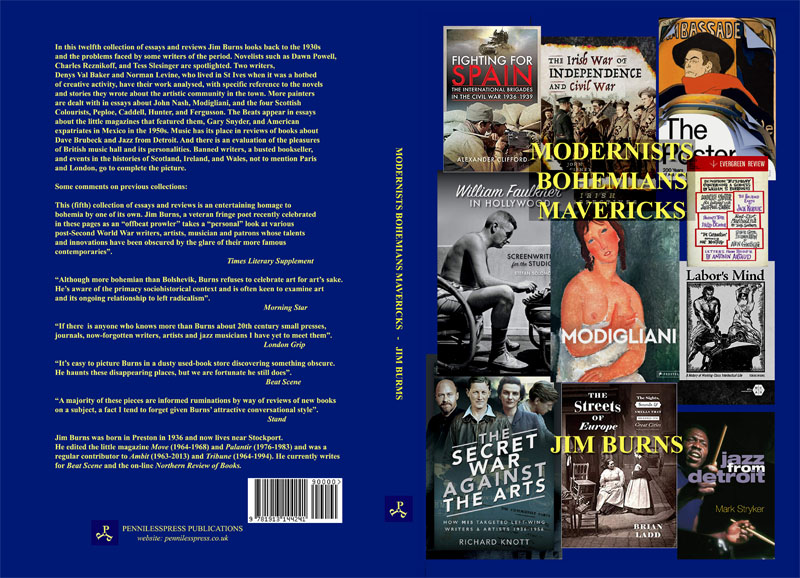
from Jim's Introduction
This twelfth
selection of reviews and essays kicks off with a couple of personal pieces
which, taken together, might provide a pointer to some of my concerns over
the years. I’ve always been fascinated by the history of bohemia, in both
its social and literary/artistic manifestations. There’s a long catalogue of
novels, stories, poems, memoirs, and social histories dealing with bohemian
centres such as Greenwich Village, Montparnasse, Montmartre, Soho, and other
urban locations, together with artists’ colonies like St Ives, Pont-Aven and
numerous additional places where painters congregated.
There are
people who dismiss the whole notion of bohemia as simply a distraction from
the work of a few geniuses who kept themselves apart from all the supposed
frivolities and created the works that are really worthy of our attention.
It seems to me that to stick to the main avenues of literature or
art, and ignore all the side-streets, minor roads, and even the cul-de-sacs,
is to miss a lot that can be entertaining. I’ve often tried to delve into
areas of activity that have been overlooked or forgotten, and in doing so
have come across numerous interesting books and fine paintings.
From
Times Literary
Supplement No 5652
July 29 2011 NB back page
Among the more agreeable
features of the literary world is the proximity of the ivory tower to the
dusty side street. The critical sage, whether he likes it or not, is
neighbour to the offbeat prowler. Jim Burns is such a one. For half a
century, he has inhabited the zone of small press and little magazine,
tracking rebel writers and syncopated songsters. The title of a collection
of essays, Beats, Bohemians and Intellectuals (2001), sums him up.
Now Mr Burns, who lives in the unlikely setting of Cheadle, Cheshire, has
issued Radicals, Beats and Beboppers. Its thirty items appeared
originally in publications many readers of this journal will not have heard
of: Beat Scene, Prop 3, Penniless Press. Many of its characters are
likewise tributarial: Maxwell Bodenheim, Walter Lowenfels, Anatole Broyard.
Mr Burns can tell you
what Jack Kerouac was reading in 1941 - the novels of Albert Halper, whoever
he was - how the screenplay of The Sweet Smell of Success by Clifford
Odets differs from the novella by Ernest Lehman, on which it is based; what
sort of music Jackson Pollock listened to while painting. Burns dismisses
the suggestion that Pollock found in the "speed and jarring harmony" of
bebop "an apt analogue to his own work". Sometimes he listened to classical
music.
An essay on Robert
McAlmon, owner of Contact Editions which issued Hemingway's first book,
Three Stories & Ten Poems, begins with the unarguable assertion, "Few
people today read McAlmon's poetry". Mr Burns shows how McAlmon moved from
"poetic language" to "ideas" to a sort of sub-Waste Land verse. By
the time he reaches McAlmon's toilet-paper poem ("Inferior goods make scabs
/ that turn the best people to crabs"), you might think forgetting is the
kindest treatment; but you remain grateful to Mr Burns for having done the
legwork. Radicals, Beats & Boppers is available from Penniless Press
Publications.