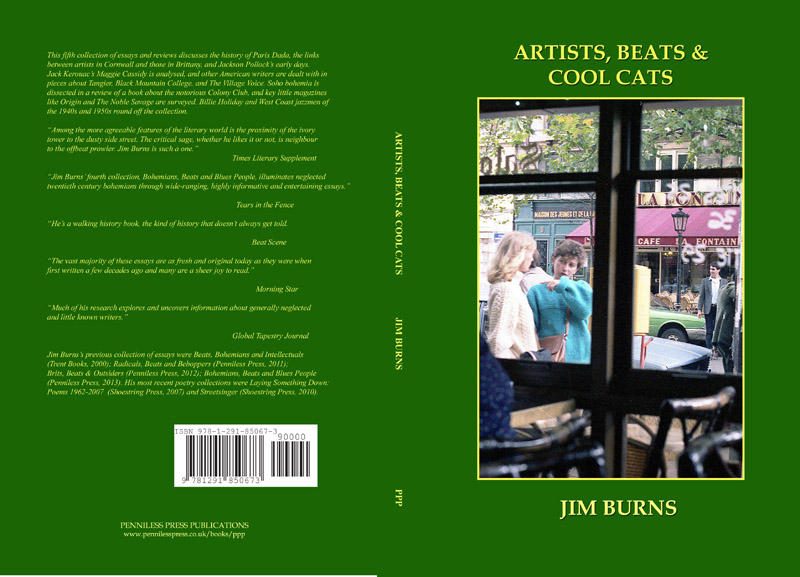
from Jim's Introduction
This fifth collection of essays and reviews ranges over a
variety of subjects, some of them connecting to material in the earlier
books. The Beats are an obvious example, though it’s perhaps using the term
loosely to link someone like Herbert Gold with them. But he did comment on
the Beats in writing and perhaps saw himself as having had experiences which
gave him insights into what Kerouac and Ginsberg and the others were doing.
I’ve included a short piece about an obscure poet, Marty Matz, because it
shows what fringe figures like him got up to. And Robert Reisner was someone
who was on the fringes of the bohemian scene, though in a more productive
way than Matz. It seems to me that people like Reisner ought to be
remembered, if only in a short article.
There are surveys of several little magazines, as there
were in my previous collections. I’ve always thought that they deserve to be
written about because of how they can often evoke a particular period better
than a detached history can. And there are often poems, stories, essays, and
other items in them which may never have been reprinted in book form, but
which have much to offer to alert readers. Forgotten and overlooked writers
are a constant source of discovery and pleasure for me.
Paperback 6" x 9" 249pp ISBN 978-1-291-85067-3
published August 2014
Ebook (EPUB) ISBN 9780244076672 published March
2018 price £0.99 to buy click on
http://www.lulu.com/shop/jim-burns/artists-beats-and-cool-cats/ebook/product-23572967.html
From
Times Literary
Supplement No 5808
July 25 2014
This collection of reviews and essays is an entertaining homage to
bohemia by one of its own. Jim Burns - a veteran fringe poet recently
celebrated in these pages as "an offbeat prowler" - takes a "personal" look
at various post-Second World War writers, artists, musicians and patrons,
many of whose talents and innovations have been obscured by the glare of
their more famous contemporaries. As he puts it in his introduction,
"forgotten and overlooked writers are a constant source of discovery and
pleasure for me". Beyond these "beautiful failures", Burns also fills in the
gaps left by "the mini-industry" around select members of the
counter-cultural canon - from Jack Kerouac, Allen Ginsberg and William
Burroughs to Jackson Pollock, Willem De Kooning and Mark Rothko.
Spanning forty years of passionate and professedly non-academic
criticism, Artists, Beats and Cool Cats documents the enduring allure
of the beatnik aesthetic from the perspective of a lifelong devotee. Indeed,
Burns is at his most interesting when examining his own emotional and
artistic responses to particular works - in a retrospective piece on
Kerouac's Maggie Cassidy, for example, he evokes his teenage thrill
at finding a kindred, jazz-inspired voice. Later, describing Robert
McAlmon's failure to deliver on his early promise, Burns astutely observes
that "his poems [are] often prosaic, his prose clumsy and slipshod. And yet
something shines through the shortcomings. Call it honesty, if you will, but
it holds the attention". Though Burns understands experimental artistic
undertakings as "acts of heroism", he is equally keen to point out the
superficiality and self-indulgence induced by the "Beatnik Daze": "Pity the
would-be bohemians of tomorrow", he writes in 1976; "Perhaps they'll have to
get back to writing, painting, etc, if there's nothing else unconventional
to do".
Burns's essay on Yiddish poetry offers a fascinating glimpse into New
York in the 1910s and a movement whose immigrant members also "worked in
sweatshops, or had jobs as painters and decorators, night watchmen, and
shoemakers". Other highlights include an essay on the Olympia Press
proprietor Maurice Girodias, who defied the censors to publish Henry Miller,
Burroughs and Samuel Beckett; a piece on Francis Bacon, Noel Coward and Paul
Potts at Soho's Colony Club ("a small urinal full of fractious old geezers
bitching about each other"); and a sobering comparison of Kerouac's travails
with Jack Conroy's The Disinherited, a novel about life "on the road"
during the Great Depression.
Guy Stevenson
CONTENTS
DADA IN PARIS
ANOTHER CORNWALL
SVEN BERLIN
JACKSON POLLOCK
WORDS FOR PAINTERS
MAGGIE CASSIDY
BEATNIK DAZE
ROBERT REISNER
ORIGIN
BLACK MOUNTAIN COLLEGE
THE VILLAGE VOICE
KEROUAC GOES COMMERCIAL
MARTY MATZ
TANGIER
HERBERT GOLD
OLYMPIA PRESS
THE COLONY ROOM
ART & LITERATURE
YIDDISH POETS
AN ARMY OF PHANTOMS
DOROTHY PARKER
BEAUTIFUL FAILURES
WRITE AS SHORT AS YOU CAN
THE NOBLE SAVAGE
THE OBJECTIVISTS
DRUMS WITHOUT END
HARD TRAVELLING
MISSION TO MOSCOW
ROMANTIC REVOLUTIONARY
FILM ON THE LEFT
LITTLE MAGAZINES
MODERN READING
EDWIN BROCK
IVORY TOWERS?
THE SWINGING DETECTIVE
THE HUNT
BEBOP SPOKEN HERE
WEST COAST SOUNDS
BILLIE HOLIDAY
JOE GUY